
The Deeper Prophetic Meaning of the New Moon in Isaiah 66:23
One of the most remarkable prophetic passages concerning the New Moon appears at the very end of the biblical book of Isaiah. In Isaiah 66:23 the Lord (Yahweh) declares:
“From one New Moon to another and from one Sabbath to another, all flesh shall come to worship before Me, says Yahweh.”
This passage occurs in the context of Isaiah’s vision of the “new heavens and new earth” and presents a breathtaking picture of worldwide worship, restored creation, and humanity gathered before God. The language is universal in scope. Isaiah does not merely describe Israel worshiping God, nor a small remnant alone, but “all flesh” coming before the Lord. The Hebrew phrase kol basar (“all flesh”) consistently carries a broad meaning throughout Scripture, referring to humanity collectively and sometimes even to all living creatures.1 “And all flesh shall see the salvation of God.” — Luke 3:6 quoting Isaiah 40, and “I will pour out My Spirit on all flesh.” — Joel 2:28. This becomes especially significant because the text does not simply say all flesh will acknowledge God’s existence or power. Rather, it says all flesh shall come to worship before Him. Worship implies reverence, participation, restored relationship, and willing approach. For this reason, Isaiah 66:23 has long held an important place in discussions surrounding the ultimate reconciliation and restoration of creation.
God’s ongoing work of renewal
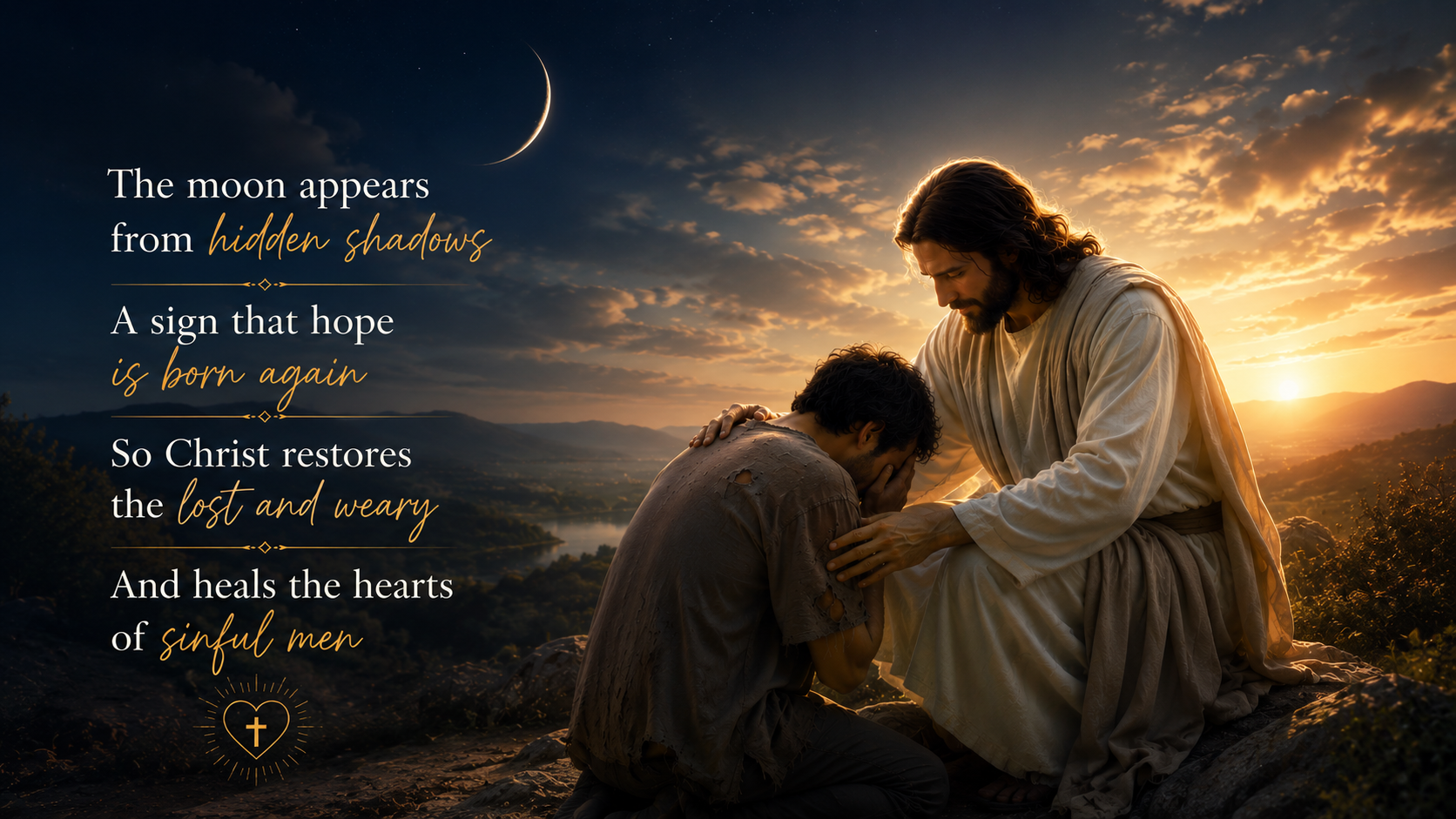
The New Moon itself carries profound symbolic meaning in this prophetic setting. In the ancient Hebrew calendar, the New Moon marked the beginning of a new cycle. It signaled renewal, reset, and fresh beginnings. Spiritually, this symbolism fits perfectly within Isaiah’s larger vision of restoration. The moon disappears into darkness and then reappears again, a recurring picture of life emerging after seeming absence. Throughout Scripture, God repeatedly brings restoration out of devastation, life out of death, and hope out of darkness. Israel’s own history followed this pattern through exile and restoration. Thus, the New Moon becomes a fitting prophetic image of God’s ongoing work of renewal within both humanity and creation itself.
Isaiah 66 intentionally links the New Moon with the “new heavens and new earth” described immediately beforehand:
“For as the new heavens and the new earth which I will make shall remain before Me… so shall your descendants and your name remain. And from one New Moon to another… all flesh shall come to worship before Me.”
The flow of thought suggests that the New Moon functions as part of the rhythm of renewed creation. It is almost as though creation itself beats with a liturgical heartbeat of renewal and communion with God. Some interpreters therefore understand the language symbolically rather than strictly ceremonially. The point may not necessarily be that lunar feast observances continue forever in a literalistic sense, but rather that all creation enters into harmonious alignment with God’s presence and purposes. Sacred time itself becomes transformed into ongoing worship.
Restoration after Darkness.
This imagery also reflects one of the dominant themes throughout Isaiah: the reversal of exile. Again and again Isaiah describes humanity scattered, alienated, rebellious, and spiritually darkened, yet God continually promises restoration, healing, and gathering. Nations stream toward Zion. Former enemies are reconciled. The earth is renewed. In this light, the New Moon beautifully symbolizes restoration after darkness. Just as the moon vanishes and reappears, so too God’s redemptive work moves from judgment toward renewal. The biblical story repeatedly demonstrates that God’s final purposes are restorative rather than merely destructive.
Early Church Fathers
Early Christian interpreters often approached passages like Isaiah 66 spiritually and cosmically rather than merely ritually. Writers such as Origen and Gregory of Nyssa frequently understood Old Testament feasts, Sabbaths2, and New Moons as shadows pointing toward deeper realities fulfilled in Christ. This understanding aligns with Paul’s statement in Colossians 2:16–17 that such observances were “a shadow of things to come, but the substance belongs to Christ.” For these early Christian thinkers, the recurring New Moon could symbolize continual spiritual renewal, the healing of the soul, and creation progressively entering into harmony with God3. Worship in Isaiah 66 therefore became not merely ceremonial observance but a vision of cosmic restoration.
Universalist Interpretation
The universal scope of Isaiah’s prophecy has especially attracted Christian universalist interpretation. Several features stand out. First, “all flesh” comes before God in worship. The text does not portray humanity eternally segregated from God’s presence. Second, the worship is continual: “from one New Moon to another.” The imagery suggests enduring participation in divine life and communion rather than temporary acknowledgment. Third, the entire setting is one of renewed creation, not endless ruin. Isaiah’s vision harmonizes naturally with New Testament passages speaking of “the restoration of all things” (Acts 3:21), God reconciling “all things” to Himself through Christ (Colossians 1:20), and the day when God becomes “all in all” (1 Corinthians 15:28).
Some Christians have also seen symbolic meaning in the moon itself. The moon possesses no light of its own but reflects the light of the sun. Spiritually, this became a picture of humanity reflecting the glory of God through Christ. In this framework, the New Moon represents humanity continually renewed by divine light, moving from darkness into reflected glory. The imagery harmonizes beautifully with passages such as Proverbs 4:18: “The path of the righteous is like the light of dawn, that shines brighter and brighter,” and Revelation 21:23, where the glory of God illuminates the renewed creation and “the Lamb is its lamp.” We Believers reflect Jesus to a dark world. Yahshua, the Malachi 4:2 “… Sun of Righteousness [Christ the “Son” of righteousness] shall arise With healing in His wings;…”
Seen in this broader biblical context, the New Moon becomes far more than an ancient calendrical observance. It joins the great biblical themes of Sabbath rest, Jubilee liberation, Passover deliverance, and new creation renewal. Together these sacred patterns point toward Messiah and God’s ultimate purpose for creation. Thus, the New Moon imagery in Isaiah 66 stands as a profound prophetic picture of continual renewal, restored humanity, cosmic worship, and creation finally living in harmony with the presence and light of God.
Brother Roger
- A few of the 37 references to “all flesh” in Scripture are Genesis 9:17, Leviticus 17:14, Numbers 16:22, Psalm 136:25 and 145:21, Jeremiah 32:27 and 1 Peter 1:24. ↩︎
- Sabbath is a day of rest and foreshadows a time of ultimate rest. Matthew 11:28-30 “Come to Me, all who are weary and heavy-laden, and I will give you rest. Take My yoke upon you and learn from Me, for I am gentle and humble in heart, and you will find rest for your souls. For My yoke is easy and My burden is light.” ↩︎
- 1 Corinthians 15:22-28 “For as in Adam all die, so also in Christ all will be made alive. But each in his own order: Christ the first fruits, after that those who are Christ’s at His coming, then comes the end, when He hands over the kingdom to the God and Father, when He has abolished all rule and all authority and power. For He must reign until He has put all His enemies under His feet. The last enemy that will be abolished is death. … When all things are subjected to Him, then the Son Himself also will be subjected to the One who subjected all things to Him, so that God may be all in all. ↩︎
Leave a Reply