
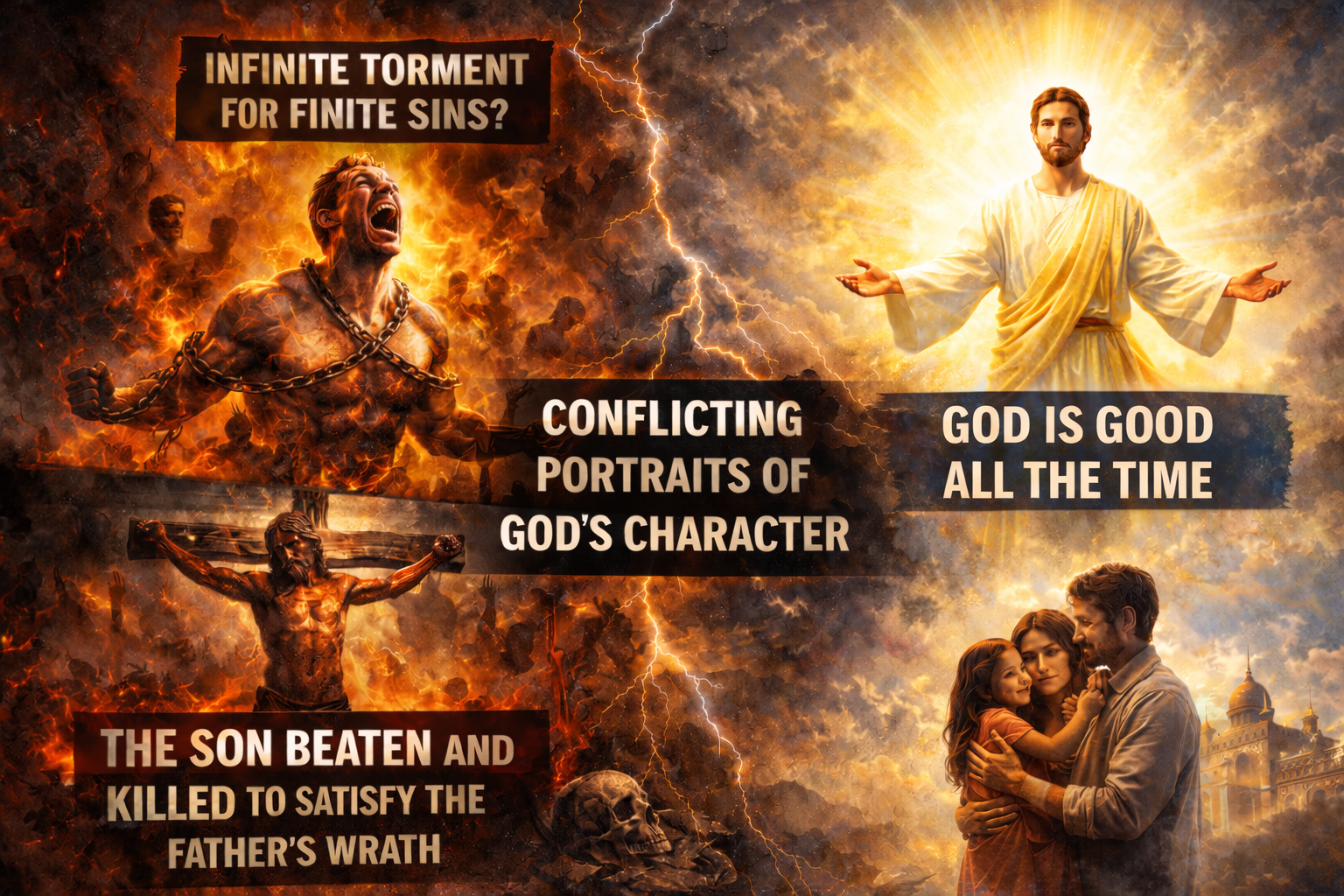
These doctrines are indeed among the most philosophically contested aspects of traditional Christian theology, particularly regarding God’s character.
Eternal Conscious Torment (ECT)
Critics argue ECT fundamentally conflicts with divine love and justice because:
Proportionality problem: Infinite punishment for finite sins seems disproportionate. Even the worst human life is temporally limited, yet ECT proposes endless suffering without rehabilitative purpose or possibility of reconciliation.
The love paradox: A God who creates beings knowing most will suffer eternally—and who maintains that suffering forever—appears incompatible with the concept of perfect love. Parents who eternally tortured their children would be considered monstrous, so why would this be virtuous in God?
Pointless suffering: Unlike corrective punishment, ECT serves no redemptive purpose—it’s retribution without end or transformation. Alternative views like annihilationism (the unsaved cease to exist) or universal reconciliation address these concerns differently.
Penal Substitutionary Atonement (PSA)
What, in a nutshell, is it? God beat and killed His own Son in order to satisfy His justice and holiness so that some of mankind could be saved from His eternal wrath. Critics see problems here too:
Justice concerns: Punishing an innocent party (Jesus) for the guilty violates basic moral intuitions about justice. We wouldn’t accept a judge sending an innocent person to prison in place of a criminal.
Relationship distortion: PSA can portray the Father as wrathful and demanding blood payment, while the Son is loving and willing to suffer—creating a divided picture of God’s character rather than unified divine love.
Transactional vs. relational: It frames salvation as a legal transaction rather than relational reconciliation, potentially reducing profound spiritual realities to courtroom mechanics.
Defenders of these doctrines offer sophisticated responses, but the tensions are real ones that theologians across traditions continue debating.
Brother Roger
Three additional blogs on the Character of God are here:
The Beast’s Blasphemy: Vilification as Spiritual Warfare
Divine Love and Eternal Torment: A Theological Examination
The Character of God in Revelation 20-22: A Linguistic and Theological Comparison
Leave a Reply