
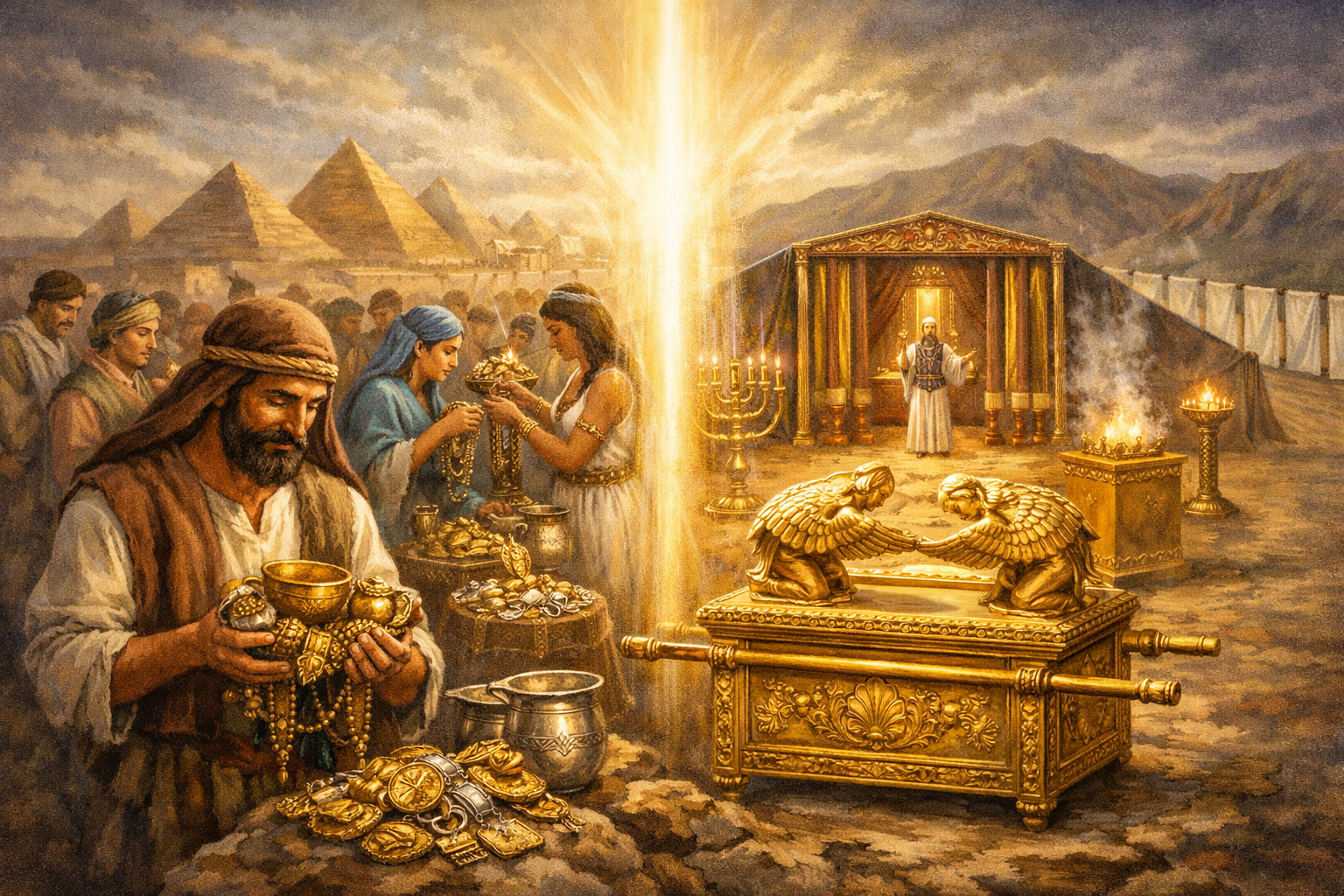
“And the LORD [Yahweh] had given the people favor in the sight of the Egyptians, so that they let them have their request. Thus they plundered the Egyptians.” Exodus 12:36.
In general, the things we own reflect who we are.1
One of the more intriguing moments in the Exodus story occurs just before Israel leaves Egypt. After centuries of slavery, God instructs the Israelites to ask their Egyptian neighbors for articles of silver and gold. Remarkably, the Egyptians give them willingly. Scripture says the Israelites “plundered the Egyptians.”2
At first glance, this event may seem strange. Why would God instruct His people to take the wealth of Egypt? In context, it represents both justice and restoration. The Israelites had labored for generations as slaves, building Egyptian cities and wealth without pay. The silver and gold they received can rightly be understood as long-overdue compensation for their forced labor. But the story does not end there.
Refined for Yahweh to Dwell Among Them
Later in the book of Exodus, these same precious metals reappear, evidently after being refined, in a surprising place: the construction of the Tabernacle. Gold and silver that once belonged to and represented a pagan empire are now used to build the dwelling place of the God of Israel. The Ark of the Covenant, the lampstand, and other sacred objects are fashioned from these materials. What had once been associated with Egypt’s idolatrous culture becomes part of the worship of the true God.3
This transformation suggests a deeper biblical pattern. God does not merely destroy what is corrupted by paganism; He can redeem and repurpose it. What was once misused can be refined and placed into holy service. The Exodus story therefore becomes a picture of redemption of the Egyptians: that which belonged to darkness can, through God’s intervention and refinement, become part of His dwelling. He has long desired to dwell and tabernacle.4
The Egyptian gold symbolizes people themselves — refined and later welcomed into God’s presence. This idea fits well with a major biblical metaphor. Throughout Scripture, people are compared to precious metals being refined.
Malachi 3:2–3 – God refines like a refiner of silver.
1 Peter 1:7 – Faith is refined like gold in fire.
Early Christian theologians recognized this symbolic meaning. Irenaeus of Lyons argued that the gold and silver always belonged to God, since He is the creator of all things and He created mankind giving Him “ownership.” The Egyptians had misused these materials for idols, but God reclaimed them and redirected them for sacred purposes.5
Similarly, Origen of Alexandria saw the episode as a spiritual metaphor. He taught that just as Israel took the wealth of Egypt and used it for the Tabernacle, Christians could take useful knowledge from pagan cultures and dedicate it to the service of God. Truth, wherever it is found, ultimately belongs to the Creator.6
God’s redemptive work
Seen through this lens, the spoiling of the Egyptians illustrates a powerful theme that runs throughout Scripture: God’s redemptive work often involves transformation rather than simple destruction. What once belonged to the world can be purified and restored for His glory in including, most of all, mankind.
Even the prophets hint that the nations themselves—including Egypt—will one day share in God’s blessing. In a striking prophecy, Isaiah records the Lord declaring, “Blessed be Egypt my people.”7 Here Egypt—once Israel’s oppressor—is called “my people.” If so, the gold of Egypt used in the Tabernacle may serve as a fitting symbol: what once stood outside the covenant can, after refinement, become part of God’s dwelling.
Conclusion
Putting the pieces together, your idea can be summarized like this: Egypt represents pagan humanity. Its gold and silver symbolize valuable but unrefined people and cultures. Through God’s refinement (judgment and deliverance), these are “plundered” from darkness. After refinement, they become part of God’s dwelling place. In Christian theology, the New Testament later expands this idea: 1 Corinthians 3:16 – Believers are God’s temple. Ephesians 2:11–22 – People from many nations become a dwelling place for God.
So what was literal gold in Exodus becomes precious born-again people in the church of the living God. God does not merely take Egypt’s wealth. He transforms it and uses it for His dwelling. In the same way, God does not ultimately discard humanity but refines and restores it.
Enjoy this song:
Footnotes
- Many of our possessions do reflect aspects of who we are, but they are imperfect and sometimes misleading mirrors of our identity.
Psychologists describe an “extended self” in which certain possessions (clothes, tools, cars, homes, digital items) are experienced as part of our identity rather than as neutral objects. People often use things symbolically to express values, roles, and group membership—for example, religious symbols, team jerseys, musical instruments, or books that signal interests and beliefs. ↩︎ - Exodus 3:22; 11:2; 12:35–36 ↩︎
- Exodus 25:1–8; 35:21–29; 37:1–24. ↩︎
- Exodus 25:8 “Let them construct a sanctuary for Me, that I may dwell among them.” ↩︎
- Irenaeus of Lyons, Against Heresies, IV.30.3–4. ↩︎
- Origen of Alexandria, Homilies on Exodus, Homily 9. ↩︎
- Isaiah 19:23–25. ↩︎
Leave a Reply