
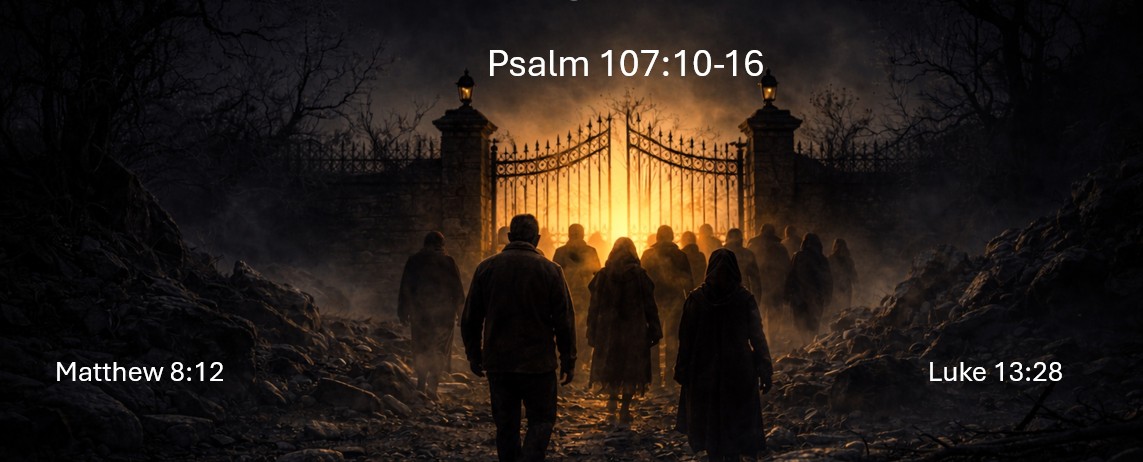
Matthew 8:11-12, “Many coming from east and west, reclining at the table with Abraham, Isaac and Jacob in the kingdom of heaven, but the sons of the kingdom being cast out into the outer darkness where there will be weeping and gnashing of teeth,” and its parallel but more in depth passage in Luke 13:22-30 present one of Jesus’s most challenging teachings about the narrow door, divine judgment, and exclusion from the kingdom of God. Looking at the Luke passage we see it contains vivid imagery: a shut door, people standing outside weeping and gnashing their teeth, and a great reversal where “some who are last will be first.” Traditional interpretations have often read this as a warning about eternal damnation, but Christian universalists offer a significantly different understanding—one that takes the warnings seriously while seeing them as ultimately restorative rather than finally destructive.
This article explores how universalists interpret this passage, contrasts their reading with traditional torture in the Lake of Fire and annihilationist views, examines the underlying Greek terminology, and surveys what the early church fathers said about these themes.
The Universalist Interpretation of Luke 13:22-30
Christian universalists do not minimize the severity of Jesus’s warnings in this passage. Instead, they understand them as describing real, necessary judgment that is nonetheless remedial rather than retributive—painful but ultimately restorative rather than eternally destructive.1
The Narrow Door: Urgency, Not Eternal Destiny
When Jesus instructs his hearers to “make every effort to enter through the narrow door” (Luke 13:24), universalists interpret this as a call to present repentance rather than a statement about most people being eternally damned.2 The narrow door represents responding to Jesus during this life, particularly rejecting self-righteousness, apathy, and presumption that block people from entering God’s kingdom now. The emphasis falls on the urgency of the moment rather than on permanent exclusion from future salvation.
This interpretation finds support in the Greek verb ἀγωνίζεσθε (agōnizesthe), a present imperative indicating continuous, active effort.3 The grammatical construction emphasizes ongoing struggle in the present rather than making metaphysical claims about eternal destiny.
Being Shut Out: Real but Temporary Judgment
The imagery of people standing outside a shut door, pleading “Sir, open the door for us” only to hear “I don’t know you or where you come from” (Luke 13:25), strikes readers as final and devastating. Universalists acknowledge this as real judgment but argue it is neither permanent nor eternal.4
They point out that many biblical parables use closed doors as symbols of judgment or loss without implying literal, unchangeable banishment. The “weeping” represents the painful awakening that comes from recognizing one’s pride and resistance to God. This judgment serves a disciplinary purpose—to bring people to genuine repentance—rather than functioning as vindictive punishment.
The Greek verb κλείσῃ (kleisē), translated “has been shut,” is an aorist subjunctive describing a completed action at a moment in time.5 Significantly, the text contains no Greek markers of eternal duration such as εἰς τὸν αἰῶνα (eis ton aiōna, “forever”), ἀτελεύτητος (ateleutētos, “endless”), or ἀεί (aei, “always”). The grammar indicates decisive judgment without specifying permanent exclusion.
The Great Reversal: Evidence of Future Restoration
Jesus’s teaching that “people will come from east and west and north and south, and will take their places at the feast in the kingdom of God” followed by the statement that “some who are last will be first, and some who are first will be last” (Luke 13:29-30) holds special significance for universalists.6
This reversal theme suggests movement rather than fixed states. If those currently “outside” can eventually come “inside,” and if the proud can be humbled while the humble are exalted, this indicates fluidity that conflicts with the concept of an eternally frozen condition after death. The passage emphasizes God overturning human expectations, with surprising people—social, religious, and moral outsiders—being welcomed into the kingdom.
Weeping and Gnashing of Teeth: Purifying Fire
Universalists fully acknowledge that the judgment described as “weeping and gnashing of teeth” (Luke 13:28) is real and painful. However, they interpret this anguish as remorse and the pain of confronting truth rather than eternal torment.7
They connect this imagery to biblical texts describing God’s judgment as corrective, purifying, and ultimately leading to repentance and restoration. Malachi 3:2-3 speaks of God as a refiner’s fire purifying the sons of Levi. Hebrews 12:5-11 explicitly describes divine discipline as painful but beneficial, producing “a harvest of righteousness and peace for those who have been trained by it.” The pain in Luke 13, from this perspective, constitutes part of a redemptive process rather than pointless eternal suffering.
The Patriarchs’ Presence: Inclusion, Not Eternal Exclusion
When Jesus says “you will see Abraham, Isaac and Jacob and all the prophets in the kingdom of God, but you yourselves thrown out” (Luke 13:28), universalists interpret this as addressing present attitudes rather than making metaphysical claims about eternal states.8
The point, they argue, is not “some will be saved forever while others are damned forever,” but rather “those you assumed would be excluded are actually included, and your current attitude toward God determines your present standing.” This functions as a warning against presumption—particularly for religious leaders who assumed their heritage guaranteed their place—rather than a statement about unending hell.
Biblical Context Supporting Restoration
Universalists situate Luke 13:22-30 within the broader scriptural witness to God’s redemptive purposes. They point to passages describing God’s desire that all be saved (1 Timothy 2:4), Christ drawing all people to himself (John 12:32), every knee bowing and tongue confessing Jesus as Lord (Philippians 2:10-11, interpreted as voluntary worship rather than forced submission), and God reconciling all things to himself (Colossians 1:20).9
Within this theological framework, Luke 13’s warnings remain serious and consequential but not finally determinative. The passage describes the urgency of repentance and the painful consequences of rejecting God, but these serve God’s ultimate purpose of universal reconciliation rather than contradicting it.
Comparative Analysis: Three Views on Luke 13:22-30
To understand the universalist interpretation more clearly, it helps to compare it with the two other major Christian positions: traditional eternal conscious torment and annihilationism.
The Narrow Door
Traditional View: Only a limited number truly enter; the narrow door represents final salvation, and the majority will perish eternally. This reading emphasizes the exclusivity of salvation and the sobering reality that many will not be saved.10
Annihilationist View: The door leads to immortality, which is a gift rather than an inherent human quality. Those who refuse entry are shut out and eventually destroyed rather than tormented forever. Few find the path to life, but those who miss it cease to exist rather than suffering eternally.11
Universalist View: The door refers to repentance in the present rather than eternal destiny. Missing it results in temporary exclusion and severe correction but not eternal loss. The narrow door emphasizes the difficulty and cost of discipleship now rather than making claims about the percentage of humanity ultimately saved.12
“I Do Not Know You”
Traditional View: This represents God’s permanent rejection of the unrepentant—a final judgment with no possibility of reversal. The closed door symbolizes the end of opportunity for salvation.13
Annihilationist View: God genuinely rejects the unrepentant, who will eventually cease to exist after facing judgment. The rejection is real and final but ends in non-existence rather than eternal suffering.14
Universalist View: This represents real rejection that is nonetheless temporary and disciplinary, intended ultimately to bring about repentance and restoration. The “not knowing” reflects the current state of the relationship rather than an eternally unchangeable condition.15
Weeping and Gnashing of Teeth
Traditional View: This describes eternal anguish in hell—conscious, everlasting suffering. The phrase appears multiple times in the Gospels (Matthew 8:12, 13:42, 13:50, 22:13, 24:51, 25:30, Luke 13:28) and consistently refers to the torment of the damned.16
Annihilationist View: This represents intense grief and fear experienced prior to final destruction. The agony is real but temporary, ending when the person is annihilated. The phrase describes the horror of facing judgment and realizing what has been lost.17
Universalist View: This describes the remorse and pain of judgment—purifying sorrow that leads toward eventual healing rather than hopeless eternal suffering. The gnashing of teeth represents bitter regret and the painful process of confronting one’s sins, but serves a restorative purpose.18
Seeing the Patriarchs but Being Thrown Out
Traditional View: This depicts final separation—some forever inside the kingdom, others forever outside. The vision of what could have been intensifies the suffering of the lost.19
Annihilationist View: The lost glimpse what they have rejected just before being destroyed. This final awareness of missed opportunity precedes their annihilation.20
Universalist View: This refers to a reversal experienced by the proud rather than describing a final state. Being “outside” is real and painful but not permanent. The humiliation serves to break down pride and eventually lead to repentance.21
People Coming from East and West
Traditional View: Gentiles and unexpected people will be saved, expanding salvation beyond Israel, but many will still be forever lost. The passage emphasizes the surprising composition of the redeemed community.22
Annihilationist View: The interpretation largely matches the traditional view, with the distinction that the lost are destroyed rather than eternally tormented.23
Universalist View: This global, expansive inclusion of all nations hints at God’s universal drawing of humanity. The vision depicts widening rather than narrowing salvation, anticipating the eventual inclusion of all peoples.24
“Last Will Be First”
Traditional View: This describes a reversal at the final judgment affecting only the saved. The lost remain lost, but among the redeemed there will be surprising reversals of earthly status and expectations.25
Annihilationist View: The reversal applies only to those who ultimately receive the gift of immortality. It does not imply hope for those who are destroyed.26
Universalist View: This represents a key theme suggesting that those who begin outside can end inside. It points toward movement and transformation rather than frozen eternal status, indicating that present exclusion need not be permanent.27
Greek Linguistic Analysis
Understanding how the original Greek text functions proves crucial for evaluating these competing interpretations. Several key terms and grammatical features deserve attention.
The Absence of Explicit Eternality Language
Perhaps most significantly, Luke 13:22-30 contains no explicit Greek terminology indicating eternal duration.28 The passage uses decisive judgment language—the shut door (κλείσῃ ἡ θύρα, kleisē hē thyra), standing outside (ἔξω ἑστήκατε, exō hestēkate), weeping and gnashing of teeth (ὁ κλαυθμὸς καὶ ὁ βρυγμὸς τῶν ὀδόντων, ho klauthmos kai ho brygmos tōn odontōn)—but never employs terms that explicitly denote endless duration.
This contrasts with passages like Matthew 25:46, which uses the adjective αἰώνιος (aiōnios) to describe both punishment and life: “These will go away into eternal punishment (κόλασιν αἰώνιον, kolasin aiōnion), but the righteous into eternal life (ζωὴν αἰώνιον, zōēn aiōnion).”29 The absence of such terminology in Luke 13 leaves the duration of the judgment open to interpretation.
The Verb “Strive” (ἀγωνίζεσθε)
The command to “strive” or “make every effort” uses the present imperative ἀγωνίζεσθε (agōnizesthe), from ἀγωνίζομαι (agōnizomai), meaning to struggle, fight, or compete.30 The present tense indicates continuous action—ongoing effort rather than a single decisive moment. This grammatical construction emphasizes present response and persistent discipleship rather than making metaphysical statements about eternal destiny.
All three interpretive traditions can accommodate this emphasis on present urgency, though it fits particularly well with views stressing immediate repentance and the current implications of accepting or rejecting Jesus’s message.
The Aorist “Shut” (κλείσῃ)
The verb describing the door being shut appears in the aorist subjunctive: κλείσῃ (kleisē).31 The aorist tense typically describes a completed action viewed as a whole rather than specifying its duration. It indicates the definitive moment when the door closes but says nothing about whether it might later reopen.
Significantly, the text does not say the door is shut “forever” or employ terms indicating permanent closure. The aorist describes the punctiliar action of shutting without commenting on permanence. This grammatical ambiguity allows both for readings emphasizing finality (traditional and annihilationist) and those seeing the shut door as a severe but temporary state (universalist).
“Standing Outside” (ἔξω ἑστήκατε)
The phrase describing people standing outside uses ἔξω (exō, “outside”) with the perfect tense ἑστήκατε (hestēkate, “you stand” or “you have taken your stand”).32 This represents a locational description—where people find themselves—rather than a metaphysical statement about an eternal condition.
In Jewish parables and apocalyptic literature, standing outside typically signals shame, exclusion, or reversal but rarely implies infinite duration. The image depicts a present state resulting from past choices rather than necessarily describing an unchangeable future condition.
“Weeping and Gnashing of Teeth”
This stereotyped expression (ὁ κλαυθμὸς καὶ ὁ βρυγμὸς τῶν ὀδόντων, ho klauthmos kai ho brygmos tōn odontōn) appears frequently in Jewish apocalyptic writings and in the Gospels.33 It conveys sorrow, regret, and anger but never intrinsically specifies duration. The phrase itself remains neutral regarding whether the suffering is temporary or eternal.
Different interpretive traditions read different connotations into this expression based on their broader theological frameworks, but the Greek terminology itself does not settle the question of duration.
The Broader Context: Universal Gathering
The description of people coming “from east and west and north and south” to recline at table in the kingdom (Luke 13:29) uses strongly inclusive language.34 The four compass directions represent totality—people from everywhere. This universal gathering imagery sits somewhat uneasily with interpretations emphasizing that most of humanity will be excluded, though it does not absolutely require universalism.
The language of reversal combined with global inclusion creates what universalists see as a strong literary movement away from narrow exclusivism toward expansive welcome, though annihilationists and traditionalists can interpret this as referring to the surprising ethnic and social composition of the saved remnant.
Linguistic Conclusion
Evaluated strictly on Greek linguistic grounds without importing theological presuppositions, the passage most naturally supports interpretations emphasizing:
- Present urgency and the current stakes of responding to Jesus
- Decisive judgment at a particular moment
- Real consequences for rejection
- Significant reversals of expectation
- Broader inclusion than Jesus’s hearers anticipated
The Greek does not demand any particular view of the duration of post-mortem judgment, though the absence of explicit eternality language combined with reversal themes and universal gathering imagery creates a text somewhat more amenable to universalist and annihilationist readings than to traditional eternal conscious torment—at least when considered in isolation from other biblical texts.35
The Critical Term: αἰώνιος (Aiōnios) and Early Christian Usage
Although αἰώνιος (aiōnios) does not appear in Luke 13:22-30, understanding how early Christians used this term proves essential for the broader debate about hell, judgment, and universalism. This adjective appears approximately seventy times in the New Testament and carries significant theological weight.36
Etymology and Classical Usage
The word αἰώνιος derives from the noun αἰών (aiōn), meaning “age,” “era,” or “lifetime.”37 In classical Greek, αἰώνιος functioned as an adjective meaning either:
- Temporal: Lasting for an age or indefinitely long period
- Qualitative: Pertaining to the nature or quality of an age, not necessarily indicating endless duration
This semantic range proves crucial. The term did not automatically mean “endless forever” in the modern English sense but could mean “of a long age,” “age-lasting,” or “pertaining to the age to come.”
Septuagint Usage
In the Septuagint (the Greek translation of the Hebrew Bible used by early Christians), αἰώνιος typically translates the Hebrew עוֹלָם (olam).38 In Old Testament contexts, olam frequently means:
- Long but not necessarily infinite duration
- An unspecified age or era
- Perpetuity within a particular covenant or dispensation
For example, the Aaronic priesthood is described as עוֹלָם (olam) or “everlasting” (Exodus 40:15), yet this priesthood was superseded in Christian theology by Christ’s eternal priesthood. The term indicated endurance within God’s purposes rather than absolute metaphysical infinity.
Similarly, Psalm 90:2 in the Septuagint uses αἰώνιος twice: “from everlasting to everlasting” (ἀπὸ τοῦ αἰῶνος ἕως τοῦ αἰῶνος, apo tou aiōnos heōs tou aiōnos), which more literally means “from age to age.”39
New Testament Usage
In the New Testament, αἰώνιος appears in several theologically significant contexts:
Eternal Life (ζωὴ αἰώνιος, zōē aiōnios): This phrase appears dozens of times, particularly in John’s Gospel.40 While often translated “eternal life,” the term emphasizes the quality and source of life—the life of the age to come, the life of God himself—rather than purely its infinite duration. This life participates in God’s own life and belongs to the eschatological kingdom.
Eternal Punishment (κόλασις αἰώνιος, kolasis aiōnios): This phrase appears in Matthew 25:46.41 Traditional interpreters understand this as conscious suffering without end. Universalists argue it could mean “age-lasting punishment”—severe and irreversible within a particular age but not necessarily perpetual. Annihilationists interpret it as punishment whose consequences are permanent (death/destruction) rather than punishment that continues forever.
Age-to-Come Language: The New Testament frequently speaks of “this age” (ὁ αἰὼν οὗτος, ho aiōn houtos) and “the age to come” (ὁ αἰὼν μέλλων, ho aiōn mellōn).42 In this framework, αἰώνιος often carries the sense of “belonging to the age to come” or “pertaining to God’s future kingdom” rather than simply “infinite in duration.”
Early Christian Interpretations
The early church fathers did not interpret αἰώνιος uniformly. Three distinct streams of interpretation emerged:
Universalist/Origenist Interpretation
Origen of Alexandria (185-254) represents the most influential early advocate of universal restoration. He argued that αἰώνιος describes age-long or remedial duration rather than absolute endlessness: “Eternal punishment is not endless but lasts for a long period sufficient to cleanse the soul.”43
Origen understood punishment as medicinal—designed to purify and heal rather than to inflict retributive suffering forever. The “eternity” of punishment referred to its quality and thoroughness rather than its infinite temporal extension.
Gregory of Nyssa (335-395), one of the Cappadocian Fathers and a canonized saint in both Eastern Orthodox and Catholic traditions, similarly taught that αἰώνιος referred to the divine age or restorative process rather than unending torment.44 He wrote that “all evil will be brought to nothing… all will be restored to the state of the good.” His interpretation of αἰώνιος punishment emphasized its corrective, transformative purpose within God’s ultimate plan to restore all creation.
Clement of Alexandria (150-215) taught that “God’s punishments are saving and disciplinary, leading to conversion… God does not punish for revenge.”45 He understood αἰώνιος punishment as belonging to the purifying fires of God’s love rather than vindictive eternal torment.
Annihilationist Interpretation
Irenaeus of Lyons (130-202) represents the clearest early voice for what later became known as conditional immortality or annihilationism. He wrote: “The lost deprive themselves of continuance forever… the penalty is that they shall not receive life.”46
For Irenaeus, αἰώνιος life represents a gift granted only to the saved. The wicked face αἰώνιος destruction—a permanent state of non-existence rather than endless conscious torment. The punishment is eternal in its consequences (permanent death) but not in conscious experience.
Traditional Eternal Torment Interpretation
Augustine of Hippo (354-430) proved most influential in establishing the traditional Western view. He argued that αἰώνιος must mean “without end” when applied to punishment, drawing a parallel with eternal life: “The punishment of the damned shall be eternal, in contrast with the eternal life of the saints.”47
Augustine’s interpretation in The City of God (Book 21) systematically addressed universalist arguments. He contended that if αἰώνιος means “eternal” when applied to life, consistency demands it mean “eternal” when applied to punishment. His reasoning proved decisive for Western Christianity, though Eastern Christianity maintained greater diversity of interpretation.
Tertullian (160-225) similarly asserted: “The punishment of the lost is everlasting, and the fire is eternal.”48 His approach, like Augustine’s, interpreted αἰώνιος as indicating absolute endless duration.
Why This Matters for Luke 13:22-30
The significance of αἰώνιος usage for interpreting Luke 13:22-30 emerges from what the passage does not say. Luke 13 employs decisive judgment language—the shut door, exclusion, weeping—but never uses αἰώνιος or any other explicit marker of eternal duration.49
This absence creates interpretive space. Texts like Matthew 25:46, which explicitly use αἰώνιος for punishment, require interpreters to grapple directly with the term’s meaning. Luke 13:22-30 can be interpreted as describing temporary, corrective, or age-long judgment without contradicting the Greek text itself.
Traditional eternal hell interpretations typically rely on:
- Reading Luke 13 in light of other passages that do use αἰώνιος (like Matthew 25:46)
- Theological inference about the nature of divine judgment
- The assumption that decisive language implies permanent outcomes
Universalist interpretations argue:
- Luke 13 describes real but non-eternal judgment
- αἰώνιος in other passages can bear interpretations consistent with ultimate restoration
- The reversal themes and inclusive language point toward eventual universal reconciliation
Annihilationist interpretations contend:
- Luke 13 describes decisive exclusion leading to destruction
- αἰώνιος in punishment contexts describes permanent consequences (destruction) not perpetual experience
- The language emphasizes the finality of losing eternal life rather than gaining eternal torment
Summary of αἰώνιος Debate
The interpretation of αἰώνιος significantly shaped Christian eschatology, yet the term itself carried semantic range that early Christians understood differently:
- Universalists emphasized its connection to “age” and its use in contexts suggesting remedial, transformative purposes
- Annihilationists emphasized the permanent consequences of punishment while denying ongoing conscious experience
- Traditionalists emphasized parallelism between eternal life and eternal punishment, arguing for symmetrical infinite duration
Modern scholarship recognizes this diversity of early Christian interpretation. The consensus that αἰώνιος necessarily means “endless” represents a later development, primarily through Augustine’s influence in the West, rather than the uniform understanding of the earliest centuries.50
Patristic Voices: What the Early Church Fathers Said
The early church fathers spoke extensively about judgment, hell, and the fate of the wicked, but they did not speak with one voice. Modern scholarship has identified three distinct streams of thought existing simultaneously in the first five centuries of Christianity.51
Fathers Supporting Universal Restoration
Clement of Alexandria (150-215)
Clement, head of the famous Catechetical School of Alexandria, taught that divine punishment serves educational and purifying purposes rather than retributive ends. He wrote: “God’s punishments are saving and disciplinary, leading to conversion… God does not punish for revenge.”52
For Clement, the fires of judgment burn away sin while preserving the sinner, much as refining fire purifies metal. This pedagogical understanding of punishment pervades his Stromata (Miscellanies), where he argues that God’s love never abandons even the worst sinners but works toward their ultimate restoration.
Origen of Alexandria (185-254)
Origen stands as the most systematic and influential early advocate of universal restoration (apokatastasis). His On First Principles (De Principiis) presents a comprehensive theological framework arguing that “the end is always like the beginning: that all things may be restored… until God is all in all.”53
Origen’s restoration theology rests on several pillars:
- God’s love and justice work together toward redemption, not contradiction
- Punishment serves medicinal, corrective purposes
- Free will persists beyond death, allowing continued moral development
- All rational beings will eventually freely choose God
- The ultimate goal is universal participation in divine life
Though later condemned (primarily for other theological views), Origen’s influence on Eastern Christianity remained substantial. His universalism represented a serious theological position rather than a fringe speculation.
Gregory of Nyssa (335-395)
Gregory, brother of Basil the Great and one of the three Cappadocian Fathers, taught universal restoration while maintaining full orthodox standing in the church. His treatise On the Soul and Resurrection presents his sister Macrina articulating a vision where “all evil will be brought to nothing… all will be restored to the state of the good.”54
Gregory’s restoration theology emphasizes:
- God’s goodness as the ultimate reality that all will eventually recognize
- Evil as privation of good rather than a positive reality that could endure eternally
- Punishment as purifying rather than vindictive
- The resurrection as ultimately triumph over all death and evil
Significantly, Gregory remained a venerated saint in both Eastern Orthodox and Catholic traditions despite his universalist convictions, demonstrating that universalism was not considered heretical in the early centuries.
Didymus the Blind (313-398)
Didymus, who headed the Catechetical School of Alexandria, taught that “the punishments of God are medicinal, purifying the soul.”55 His Commentary on Psalms interprets judgment passages as describing temporary, corrective discipline rather than eternal retribution.
Theodore of Mopsuestia (350-428)
Theodore, bishop of Mopsuestia in Cilicia, represented the Antiochene theological tradition. He taught that “God’s goodness is so great that ultimately He brings all to His kingdom.”56 Though later condemned as part of the “Three Chapters” controversy (more for Christological views than eschatology), Theodore’s universalism was widely known and initially uncontroversial.
Fathers Supporting Annihilation or Conditional Immortality
Ignatius of Antioch (35-107)
Ignatius, who faced martyrdom under Roman persecution, wrote that those who corrupt the faith “will perish.”57 His letters emphasize the gift of immortality given to believers while suggesting the wicked simply cease to exist rather than suffering eternally.
Theophilus of Antioch (120-190)
Theophilus explicitly taught that “the unbelievers shall receive death as punishment.”58 His apologetic work To Autolycus argues that immortality represents a reward for faithfulness rather than an intrinsic human quality, implying that those who reject God lose existence rather than gaining eternal torment.
Irenaeus of Lyons (130-202)
Irenaeus, one of the most important early fathers and a key figure in establishing Christian orthodoxy, clearly taught conditional immortality: “The lost deprive themselves of continuance forever… the penalty is that they shall not receive life.”59
In Against Heresies, Irenaeus argues that God alone possesses immortality inherently. Human beings receive immortality as a gift through Christ. Those who reject this gift face permanent death—cessation of existence—rather than endless conscious suffering. This represents a decisive punishment but not eternal torment.
Fathers Supporting Eternal Conscious Torment
Tertullian (160-225)
Tertullian, the influential North African theologian who coined much Latin theological vocabulary, asserted that “the punishment of the lost is everlasting, and the fire is eternal.”60 His Apology defends Christianity against Roman critics while articulating a view of judgment involving permanent, conscious suffering for the wicked.
Hippolytus (170-235)
Hippolytus taught that “the ungodly shall be burned with everlasting fire.”61 His works reflect an early development of the traditional hell doctrine, particularly in Rome and the Latin West.
Basil the Great (330-379)
Basil, one of the Cappadocian Fathers and Gregory of Nyssa’s brother, took a different position from Gregory regarding the duration of punishment. He wrote: “The threats of the Lord are not temporary but everlasting.”62
Interestingly, Basil’s embrace of eternal punishment while his brother Gregory taught universalism demonstrates the theological diversity even among the Cappadocian Fathers. Both remained honored saints, showing the church could embrace both views.
Augustine of Hippo (354-430)
Augustine proved most decisive in establishing eternal conscious torment as Western Christian orthodoxy. His massive influence through The City of God (particularly Book 21) and other works cemented this interpretation as dominant in Latin Christianity.
Augustine argued: “The punishment of the damned shall be eternal, in contrast with the eternal life of the saints.”63 He systematically refuted universalist and annihilationist arguments, contending that:
- Scripture clearly parallels eternal life with eternal punishment
- God’s justice demands perpetual punishment for sin against an infinite being
- The wicked continue sinning in hell, thus perpetually deserving punishment
- To deny eternal hell compromises divine justice and biblical authority
Geographical and Theological Patterns
Modern scholarship has identified clear patterns in early Christian eschatology:
Greek East: Universalism flourished particularly in Alexandria and among Greek-speaking theologians. The Alexandrian school (Clement, Origen, Didymus) and several Cappadocian fathers (Gregory of Nyssa) taught universal restoration. This remained a live option in Eastern Christianity for centuries.64
Latin West: Eternal conscious torment became dominant earlier and more thoroughly in Latin-speaking Christianity, particularly through Tertullian, Hippolytus, and decisively through Augustine. The Western church largely settled this question by the fifth century.65
Antiochene School: This theological tradition, emphasizing literal biblical interpretation, produced voices supporting both universalism (Theodore of Mopsuestia) and conditional immortality, though less systematically than Alexandria.
The Historical Verdict
Multiple scholars have examined the patristic evidence. While estimates vary, a commonly cited analysis suggests that in the first five centuries:
- Universal restoration was taught by a significant minority of theologians, particularly in the East
- Conditional immortality/annihilationism had notable early supporters but became less prominent
- Eternal conscious torment gradually became the majority view, especially in the West, though never completely displacing alternatives.66
Significantly, none of these positions was formally declared heretical in the first four centuries. The councils focused on Christological and Trinitarian controversies rather than eschatology. Origen was eventually condemned (553 CE at the Fifth Ecumenical Council), but primarily for other theological speculations rather than universalism per se, and Gregory of Nyssa remained a venerated saint despite teaching similar doctrines.
Conclusion
Christian universalist interpretation of Luke 13:22-30 takes seriously Jesus’s warnings about judgment, exclusion, and suffering while understanding these as describing remedial, corrective discipline rather than retributive eternal torment. Universalists read the narrow door as emphasizing present urgency, the shut door as temporary exclusion meant to awaken repentance, the weeping and gnashing as the painful but healing process of confronting one’s sin, and the great reversals as evidence that those currently outside will eventually be brought inside.
The Greek text of Luke 13:22-30 supports this interpretation through its absence of explicit eternality language, its use of decisive but temporally ambiguous judgment imagery, its reversal themes, and its inclusion of universal gathering motifs. While the passage certainly can be read to support traditional eternal hell or annihilationist positions, the Greek linguistic evidence does not require these interpretations and arguably fits more naturally with universalist or annihilationist readings.
The debate over αἰώνιος (aiōnios) proves central to broader eschatological discussions, though this term does not appear in Luke 13. Early Christians understood this word differently—some reading it as “age-lasting” and compatible with eventual restoration, others as “everlasting” in the absolute sense. This diversity of interpretation persisted for centuries and reflected genuine theological pluralism in the early church.
The patristic evidence demonstrates that all three major positions—eternal conscious torment, annihilation, and universal restoration—existed in the early centuries of Christianity. Universalism was particularly strong in the Greek East through figures like Clement, Origen, and Gregory of Nyssa. Annihilationism found early advocates in Ignatius, Theophilus, and most clearly Irenaeus. Eternal torment gradually became dominant, especially in the Latin West through Tertullian and Augustine, though it never completely eliminated alternative views.
For contemporary readers, understanding these interpretive traditions enriches engagement with difficult biblical passages like Luke 13:22-30. The passage demands serious reflection on divine judgment, human responsibility, the consequences of rejecting God’s kingdom, and the nature of repentance. Whether one ultimately embraces traditional, annihilationist, or universalist conclusions, recognizing that faithful Christians have held all three positions throughout church history should promote theological humility and continued careful attention to Scripture.
FOOTNOTES
- Robin Parry, The Evangelical Universalist (Eugene, OR: Cascade Books, 2012), 87-91; Thomas Talbott, The Inescapable Love of God (Eugene, OR: Cascade Books, 2014), 156-159.
- Gregory MacDonald (pseudonym for Robin Parry), “All Shall Be Well: Universalism in the New Testament,” in All Shall Be Well: Explorations in Universalism and Christian Theology, from Origen to Moltmann, ed. Gregory MacDonald (Eugene, OR: Cascade Books, 2011), 37-38.
- Daniel B. Wallace, Greek Grammar Beyond the Basics: An Exegetical Syntax of the New Testament (Grand Rapids: Zondervan, 1996), 485-488 on the present imperative.
- Talbott, The Inescapable Love of God, 162-165.
- Wallace, Greek Grammar Beyond the Basics, 461-462 on the aorist subjunctive.
- Ilaria Ramelli, A Larger Hope? Universal Salvation from Christian Beginnings to Julian of Norwich (Eugene, OR: Cascade Books, 2019), 1:243-247.
- Parry, The Evangelical Universalist, 124-128.
- David Bentley Hart, That All Shall Be Saved: Heaven, Hell, and Universal Salvation (New Haven: Yale University Press, 2019), 95-99.
- Ramelli, A Larger Hope?, 1:89-93.
- Robert A. Peterson, Hell on Trial: The Case for Eternal Punishment (Phillipsburg, NJ: P&R Publishing, 1995), 147-151.
- Edward Fudge, The Fire That Consumes: A Biblical and Historical Study of the Doctrine of Final Punishment, 3rd ed. (Eugene, OR: Cascade Books, 2011), 238-242.
- Parry, The Evangelical Universalist, 89-90.
- Peterson, Hell on Trial, 152-155.
- Fudge, The Fire That Consumes, 243-246.
- Talbott, The Inescapable Love of God, 163-164.
- Peterson, Hell on Trial, 156-160.
- Fudge, The Fire That Consumes, 247-251.
- Hart, That All Shall Be Saved, 102-106.
- Peterson, Hell on Trial, 161-163.
- Fudge, The Fire That Consumes, 252-254.
- Parry, The Evangelical Universalist, 91-93.
- Peterson, Hell on Trial, 164-166.
- Fudge, The Fire That Consumes, 255-257.
- Ramelli, A Larger Hope?, 1:244-246.
- Peterson, Hell on Trial, 167-168.
- Fudge, The Fire That Consumes, 258-259.
- Hart, That All Shall Be Saved, 107-110.
- Wallace, Greek Grammar Beyond the Basics, 536-539 on temporal expressions.
- Matthew 25:46 in Greek New Testament texts; see discussion in Ramelli, A Larger Hope?, 1:156-162.
- BDAG (Bauer, Danker, Arndt, and Gingrich), Greek-English Lexicon of the New Testament, 3rd ed. (Chicago: University of Chicago Press, 2000), s.v. “ἀγωνίζομαι.”
- Wallace, Greek Grammar Beyond the Basics, 461-464 on the aorist subjunctive.
- Wallace, Greek Grammar Beyond the Basics, 579-583 on the perfect tense.
- Joel B. Green, The Gospel of Luke, New International Commentary on the New Testament (Grand Rapids: Eerdmans, 1997), 531-532.
- Green, The Gospel of Luke, 532-533.
- Ramelli, A Larger Hope?, 1:247-251 summarizes linguistic arguments.
- Ramelli, The Christian Doctrine of Apokatastasis: A Critical Assessment from the New Testament to Eriugena (Leiden: Brill, 2013), 27-45.
- BDAG, s.v. “αἰών” and “αἰώνιος.”
- Ramelli, The Christian Doctrine of Apokatastasis, 29-33.
- LXX Psalm 89:2 (MT 90:2).
- BDAG, s.v. “ζωὴ αἰώνιος”; see usage in John 3:16, 3:36, 4:14, 4:36, 5:24, 5:39, 6:27, 6:40, 6:47, 6:54, 6:68, 10:28, 12:25, 12:50, 17:2, 17:3.
- Matthew 25:46; extensive discussion in Ramelli, A Larger Hope?, 1:156-162.
- See usage in Matthew 12:32, Mark 10:30, Luke 18:30, Ephesians 1:21.
- Origen, On First Principles 2.10.4-8; see translation and discussion in Ramelli, A Larger Hope?, 1:117-123.
- Gregory of Nyssa, On the Soul and Resurrection; see Ramelli, A Larger Hope?, 1:240-267.
- Clement of Alexandria, Stromata 7.16; discussed in Ramelli, A Larger Hope?, 1:73-85.
- Irenaeus, Against Heresies 5.27.2; see discussion in Fudge, The Fire That Consumes, 79-84.
- Augustine, The City of God 21.23; see Peterson, Hell on Trial, 38-45.
- Tertullian, Apology 48; discussed in Peterson, Hell on Trial, 34-37.
- Green, The Gospel of Luke, 530-534.
- Ramelli, The Christian Doctrine of Apokatastasis, 33-45 provides detailed philological analysis.
- Ramelli, A Larger Hope?, provides the most comprehensive modern treatment, covering 1:1-800 (patristic period).
- Clement of Alexandria, Stromata 7.16; Ramelli, A Larger Hope?, 1:76-78.
- Origen, On First Principles 1.6.1; Ramelli, A Larger Hope?, 1:109-123.
- Gregory of Nyssa, On the Soul and Resurrection; Ramelli, A Larger Hope?, 1:247-251.
- Didymus the Blind, Commentary on Psalms; Ramelli, A Larger Hope?, 1:289-293.
- Theodore of Mopsuestia, fragments; Ramelli, A Larger Hope?, 1:323-328.
- Ignatius, Letter to the Ephesians 16; Fudge, The Fire That Consumes, 68-71.
- Theophilus, To Autolycus 1.14; Fudge, The Fire That Consumes, 74-76.
- Irenaeus, Against Heresies 5.27.2; Fudge, The Fire That Consumes, 79-84.
- Tertullian, Apology 48; Peterson, Hell on Trial, 34-37.
- Hippolytus, Against the Greeks 3; Peterson, Hell on Trial, 37-38.
- Basil the Great, On the Holy Spirit 15; Peterson, Hell on Trial, 38-40.
- Augustine, The City of God 21.23; Peterson, Hell on Trial, 38-45.
- Ramelli, A Larger Hope?, 1:68-328 documents this Eastern tradition extensively.
- Peterson, Hell on Trial, 34-48 traces the Western development.
- Ramelli, A Larger Hope?, 1:1-14 provides historiographical analysis; cf. also Brian Daley, The Hope of the Early Church: A Handbook of Patristic Eschatology (Cambridge: Cambridge University Press, 1991).
- Robin Parry, The Evangelical Universalist (Eugene, OR: Cascade Books, 2012), 87-91; Thomas Talbott, The Inescapable Love of God (Eugene, OR: Cascade Books, 2014), 156-159. ↩︎
- Gregory MacDonald (pseudonym for Robin Parry), “All Shall Be Well: Universalism in the New Testament,” in All Shall Be Well: Explorations in Universalism and Christian Theology, from Origen to Moltmann, ed. Gregory MacDonald (Eugene, OR: Cascade Books, 2011), 37-38. ↩︎
- Daniel B. Wallace, Greek Grammar Beyond the Basics: An Exegetical Syntax of the New Testament (Grand Rapids: Zondervan, 1996), 485-488 on the present imperative. ↩︎
- Talbott, The Inescapable Love of God, 162-165. ↩︎
- Wallace, Greek Grammar Beyond the Basics, 461-462 on the aorist subjunctive. ↩︎
- Ilaria Ramelli, A Larger Hope? Universal Salvation from Christian Beginnings to Julian of Norwich (Eugene, OR: Cascade Books, 2019), 1:243-247. ↩︎
- Parry, The Evangelical Universalist, 124-128. ↩︎
- David Bentley Hart, That All Shall Be Saved: Heaven, Hell, and Universal Salvation (New Haven: Yale University Press, 2019), 95-99. ↩︎
- Ramelli, A Larger Hope?, 1:89-93. ↩︎
- Robert A. Peterson, Hell on Trial: The Case for Eternal Punishment (Phillipsburg, NJ: P&R Publishing, 1995), 147-151. Also, all the teachings if Matthew 7 involve events for life now, on this side of heaven, so why should Matthew 7:13-14 and the narrow gate be taken out of context and applied to post Great White Throne events? ↩︎
- Edward Fudge, The Fire That Consumes: A Biblical and Historical Study of the Doctrine of Final Punishment, 3rd ed. (Eugene, OR: Cascade Books, 2011), 238-242. ↩︎
- Parry, The Evangelical Universalist, 89-90. ↩︎
- Peterson, Hell on Trial, 152-155. ↩︎
- Fudge, The Fire That Consumes, 243-246. ↩︎
- Talbott, The Inescapable Love of God, 163-164. ↩︎
- Peterson, Hell on Trial, 156-160 ↩︎
- Fudge, The Fire That Consumes, 247-251. ↩︎
- Hart, That All Shall Be Saved, 102-106. ↩︎
- Peterson, Hell on Trial, 161-163. ↩︎
- Fudge, The Fire That Consumes, 252-254. ↩︎
- Parry, The Evangelical Universalist, 91-93. ↩︎
- Peterson, Hell on Trial, 164-166. ↩︎
- Fudge, The Fire That Consumes, 255-257. ↩︎
- Ramelli, A Larger Hope?, 1:244-246. ↩︎
- Peterson, Hell on Trial, 167-168. ↩︎
- Fudge, The Fire That Consumes, 258-259. ↩︎
- Hart, That All Shall Be Saved, 107-110. ↩︎
- Wallace, Greek Grammar Beyond the Basics, 536-539 on temporal expressions. ↩︎
- Matthew 25:46 in Greek New Testament texts; see discussion in Ramelli, A Larger Hope?, 1:156-162. ↩︎
- BDAG (Bauer, Danker, Arndt, and Gingrich), Greek-English Lexicon of the New Testament, 3rd ed. (Chicago: University of Chicago Press, 2000), s.v. “ἀγωνίζομαι.” ↩︎
- Wallace, Greek Grammar Beyond the Basics, 461-464 on the aorist subjunctive. ↩︎
- Wallace, Greek Grammar Beyond the Basics, 579-583 on the perfect tense. ↩︎
- Joel B. Green, The Gospel of Luke, New International Commentary on the New Testament (Grand Rapids: Eerdmans, 1997), 531-532. ↩︎
- Green, The Gospel of Luke, 532-533. ↩︎
- Ramelli, A Larger Hope?, 1:247-251 summarizes linguistic arguments. ↩︎
- Ramelli, The Christian Doctrine of Apokatastasis: A Critical Assessment from the New Testament to Eriugena (Leiden: Brill, 2013), 27-45. ↩︎
- BDAG, s.v. “αἰών” and “αἰώνιος.” ↩︎
- Ramelli, The Christian Doctrine of Apokatastasis, 29-33. ↩︎
- LXX Psalm 89:2 (MT 90:2). ↩︎
- BDAG, s.v. “ζωὴ αἰώνιος”; see usage in John 3:16, 3:36, 4:14, 4:36, 5:24, 5:39, 6:27, 6:40, 6:47, 6:54, 6:68, 10:28, 12:25, 12:50, 17:2, 17:3. ↩︎
- Matthew 25:46; extensive discussion in Ramelli, A Larger Hope?, 1:156-162. ↩︎
- See usage in Matthew 12:32, Mark 10:30, Luke 18:30, Ephesians 1:21. ↩︎
- Origen, On First Principles 2.10.4-8; see translation and discussion in Ramelli, A Larger Hope?, 1:117-123. ↩︎
- Gregory of Nyssa, On the Soul and Resurrection; see Ramelli, A Larger Hope?, 1:240-267. ↩︎
- Clement of Alexandria, Stromata 7.16; discussed in Ramelli, A Larger Hope?, 1:73-85. ↩︎
- Irenaeus, Against Heresies 5.27.2; see discussion in Fudge, The Fire That Consumes, 79-84. ↩︎
- Augustine, The City of God 21.23; see Peterson, Hell on Trial, 38-45. ↩︎
- Tertullian, Apology 48; discussed in Peterson, Hell on Trial, 34-37. ↩︎
- Green, The Gospel of Luke, 530-534. ↩︎
- Ramelli, The Christian Doctrine of Apokatastasis, 33-45 provides detailed philological analysis. ↩︎
- Ramelli, A Larger Hope?, provides the most comprehensive modern treatment, covering 1:1-800 (patristic period). ↩︎
- Clement of Alexandria, Stromata 7.16; Ramelli, A Larger Hope?, 1:76-78. ↩︎
- Origen, On First Principles 1.6.1; Ramelli, A Larger Hope?, 1:109-123. ↩︎
- Gregory of Nyssa, On the Soul and Resurrection; Ramelli, A Larger Hope?, 1:247-251. ↩︎
- Didymus the Blind, Commentary on Psalms; Ramelli, A Larger Hope?, 1:289-293. ↩︎
- Theodore of Mopsuestia, fragments; Ramelli, A Larger Hope?, 1:323-328. ↩︎
- gnatius, Letter to the Ephesians 16; Fudge, The Fire That Consumes, 68-71. ↩︎
- Theophilus, To Autolycus 1.14; Fudge, The Fire That Consumes, 74-76. ↩︎
- Irenaeus, Against Heresies 5.27.2; Fudge, The Fire That Consumes, 79-84. ↩︎
- Tertullian, Apology 48; Peterson, Hell on Trial, 34-37. ↩︎
- Hippolytus, Against the Greeks 3; Peterson, Hell on Trial, 37-38. ↩︎
- Basil the Great, On the Holy Spirit 15; Peterson, Hell on Trial, 38-40. ↩︎
- Augustine, The City of God 21.23; Peterson, Hell on Trial, 38-45. ↩︎
- Ramelli, A Larger Hope?, 1:68-328 documents this Eastern tradition extensively. ↩︎
- Peterson, Hell on Trial, 34-48 traces the Western development. ↩︎
- Ramelli, A Larger Hope?, 1:1-14 provides historiographical analysis; cf. also Brian Daley, The Hope of the Early Church: A Handbook of Patristic Eschatology (Cambridge: Cambridge University Press, 1991). ↩︎
Leave a Reply