
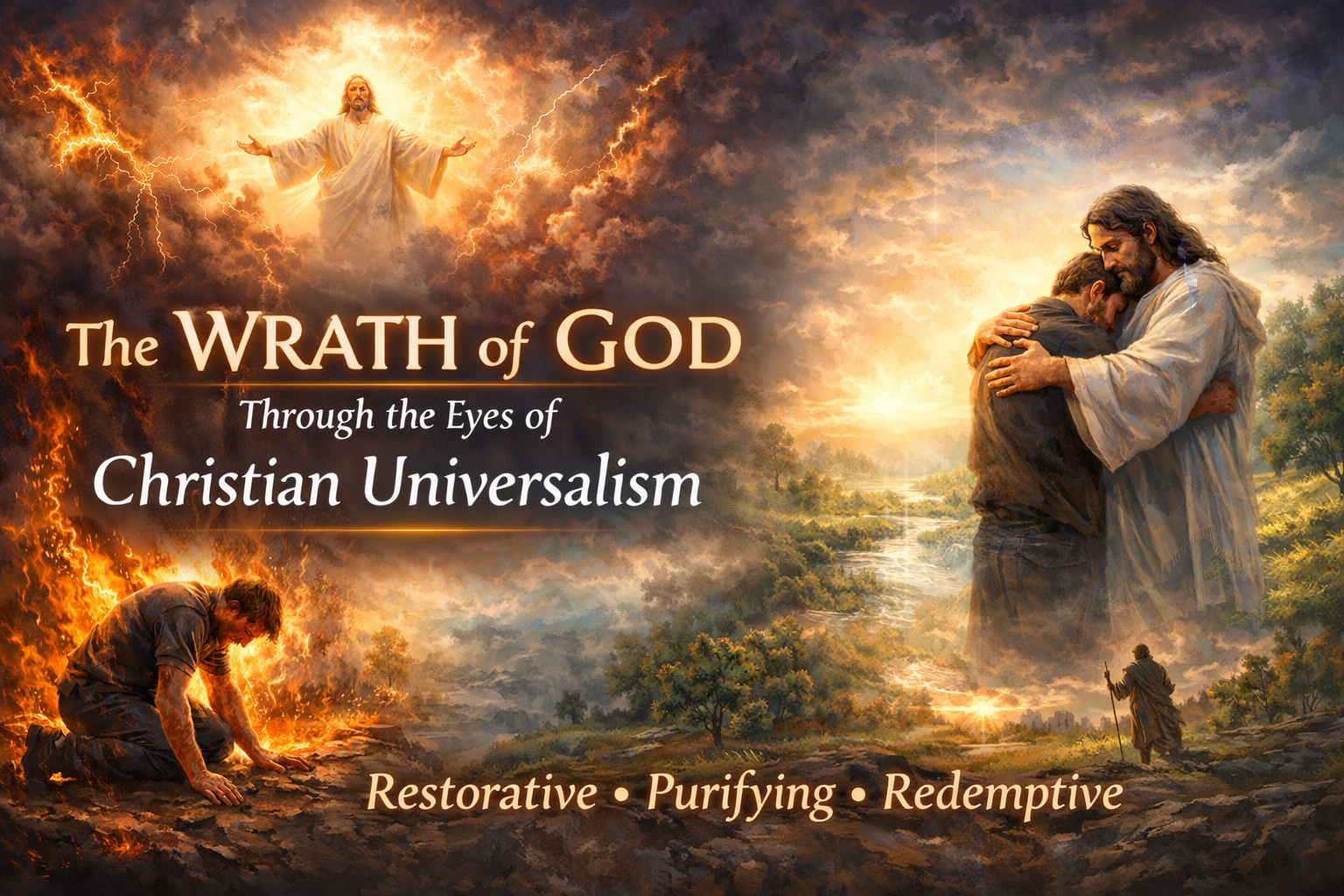
For many believers, the phrase “the wrath of God” evokes images of divine anger, judgment, and everlasting punishment. In much of popular theology, wrath is understood primarily as retributive—God inflicting eternal suffering upon sinners. And little wonder as a dictionary definition of our word wrath is “forceful, often vindictive anger, punishment or vengeance as a manifestation of anger”1. Christian universalism, however, offers a very different reading. From this perspective, God’s wrath is not opposed to His love but is an expression of it. It is not meant to destroy, but to heal. It is not final condemnation, but purposeful correction aimed at ultimate restoration.2 Can you spot this expression of His love in Strong’s Greek Concordance where he defines wrath?
Wrath is defined in Strong’s Greek Concordance #G3709. It is the Greek word orge, pronounced or-gay, properly meaning desire (as a reaching forth or excitement of the mind), that is, (by analogy) violent passion (ire, or [justifiable] abhorrence); by implication punishment. It comes from the root word # G3713 oregomai, pronounced or-eg’-om-ahee, meaning to stretch oneself, that is, reach out after (long for).
There are only two Greek words in Scripture translated as wrath, orge as set forth above and thumos, Strong’s Concordance #G2392 meaning passion. Here is another blog setting forth the number one passion and desire of our Heavenly Father Creator and Redeemer: https://thefallacyofhell.com/2026/09/22/gods-passion/
Now it is decision time: do we want to accept the meaning of “wrath” as understood at the time of the writing of Scripture, or do we want to go with today’s English meaning of extreme anger? Our choice.
Wrath as Loving Discipline
One of the central convictions of universalist theology is that God disciplines His children in love rather than punishing them in vengeance. Scripture repeatedly presents divine correction as restorative rather than vindictive. Hebrews teaches that “the Lord disciplines the one He loves” and that such discipline produces righteousness and peace.3 Likewise, the psalmist affirms that Yahweh’s anger is momentary, while His favor endures for a lifetime.4
From this standpoint, wrath is not an emotional outburst of rage but the active resistance of divine love against sin and corruption. Yahweh opposes whatever destroys His creation. Because He loves His creatures, He confronts what harms them. Just as a physician may use painful treatment to save a life, Yah applies severe mercy in order to restore His children.
Wrath as Consequence Rather Than Cruelty
Universalists also emphasize that many biblical descriptions of wrath portray Yahweh “giving people over” to the consequences of their own choices. In Romans 1, Paul explains that divine wrath is expressed when God allows people to experience the natural results of rejecting truth.5 This is not cruelty but pedagogy (the principles, practice, or profession of teaching). Yahweh permits human rebellion to run its course so that its emptiness becomes visible.
The prophetic writings reflect this same pattern. Hosea describes Yahweh allowing Israel to experience hardship so that she might return to her first love.6 Jesus illustrates this principle in the parable of the Prodigal Son, where the father never inflicts punishment, but patiently waits while the son learns through loss and famine.7 Suffering becomes the teacher that leads to repentance and reconciliation.
Judgment as Purifying Fire
Another key theme in universalist interpretation is that divine judgment is purifying rather than annihilating. Scripture frequently uses the imagery of fire to describe God’s dealings with humanity. Malachi speaks of Yahweh as a refiner who purifies precious metals.8 Paul teaches that God’s fire tests every person’s work, burning away what is worthless while preserving what is good.9 Even those whose works are destroyed are described as being “saved, yet so as through fire.”
This fire is not meant to torture but to transform. It removes falsehood, pride, and corruption so that the true self—made in Yahweh ’s image—may emerge. Judgment, therefore, is not the opposite of salvation. It is one of the means by which salvation is accomplished.
The Ultimate Purpose: Restoration of All Things
Universalists interpret divine wrath in light of Scripture’s sweeping promises of universal reconciliation. Paul declares that Yahweh desires all people to be saved.10 He proclaims that just as all die in Adam, so all will be made alive in Christ.11 He affirms that Yahweh has allowed all to experience disobedience so that He may show mercy to all.12
The New Testament consistently presents redemption as cosmic in scope. Through Christ, God reconciles “all things” to Himself.13 The final vision of Scripture is not a divided universe but one in which God becomes “all in all.”14 In this context, wrath cannot be endless. It must serve a redemptive purpose that culminates in restoration.
The Early Christian Witness
This understanding of divine judgment did not originate in modern liberal theology. It has deep roots in early Christianity. One of the earliest and most influential theologians, Origen of Alexandria, taught that Yahweh’s punishments are medicinal, designed to heal the soul and eventually restore all beings to harmony with God.15 His doctrine of apokatastasis—the restoration of all things—viewed judgment as purgative fire rather than final destruction.
In the fourth century, Gregory of Nyssa, one of the Cappadocian Fathers, affirmed that Yahweh’s goodness would ultimately overcome every form of evil. He argued that punishment exists only to remove sin, and once sin is gone, punishment has no further purpose.16 For Gregory, divine love would eventually triumph over all resistance.
The Syrian Isaac of Nineveh later taught that hell is not evidence of Yahweh’s hatred but of humanity’s resistance to divine mercy. He famously wrote that God’s justice is inseparable from compassion.17
George MacDonald and Modern Universalism
In the nineteenth century, George MacDonald revived these ancient themes in Protestant theology. MacDonald insisted that God’s wrath is simply love refusing to abandon its object. For him, God is too good to leave His children in their sins. He will pursue them relentlessly until they are healed.18
MacDonald rejected the idea that God would eternally sustain suffering for the sake of justice. True justice, he argued, restores what has been broken. Punishment that never redeems is not justice at all, but failure.
His influence extended to figures such as C. S.. Lewis, who, while not a universalist, adopted many of MacDonald’s insights about divine love and discipline.
Wrath and Love: No Contradiction
At the heart of universalist theology is the conviction that our Creator’s nature is love.19 Every divine attribute must be interpreted through this truth. If He is love, then His wrath cannot contradict His loving purpose. It must serve it.
Wrath is love in action against evil. It is love confronting deception. It is love refusing to tolerate what destroys God’s children. Far from being incompatible, wrath and mercy work together in the divine economy to bring about transformation.
Conclusion: Severe Mercy and Certain Hope
From a universalist perspective, the wrath of God is best understood as severe mercy. It is real, serious, and sometimes painful. It exposes sin, dismantles pride, and humbles the rebellious heart. Yet it never exists for its own sake. It always points beyond itself to healing and reconciliation.
Divine judgment is not the final word. Love is. Wrath is temporary; mercy is eternal. Discipline serves restoration; punishment serves redemption. In the end, God’s purposes will not fail. Every wound will be healed. Every lost sheep will be found. And every tear will be wiped away.
Enjoy a song supporting this message:
To enjoy the Country Version of this song preceded by a two minute blog introducing it, click here.
Footnotes
- American Heritage® Dictionary of the English Language, Fifth Edition. Copyright © 2016 by Houghton Mifflin Harcourt Publishing Company. Published by Houghton Mifflin Harcourt Publishing Company ↩︎
- Lamentations 3:31–33. ↩︎
- Hebrews 12:6, 10–11. ↩︎
- Psalm 30:5. ↩︎
- Romans 1:24, 26, 28. ↩︎
- Hosea 2:6–7. ↩︎
- Luke 15:11–24. ↩︎
- Malachi 3:2–3. ↩︎
- 1 Corinthians 3:13–15. ↩︎
- 1 Timothy 2:4. ↩︎
- 1 Corinthians 15:22–28 ↩︎
- Romans 11:32. ↩︎
- Colossians 1:19–20. ↩︎
- 1 Corinthians 15:28. ↩︎
- Origen, On First Principles, I.6.3. ↩︎
- Gregory of Nyssa, On the Soul and the Resurrection. ↩︎
- Isaac of Nineveh, Ascetical Homilies. ↩︎
- George MacDonald, Unspoken Sermons, Series I–III. ↩︎
- 1 John 4:8. ↩︎
Leave a Reply