
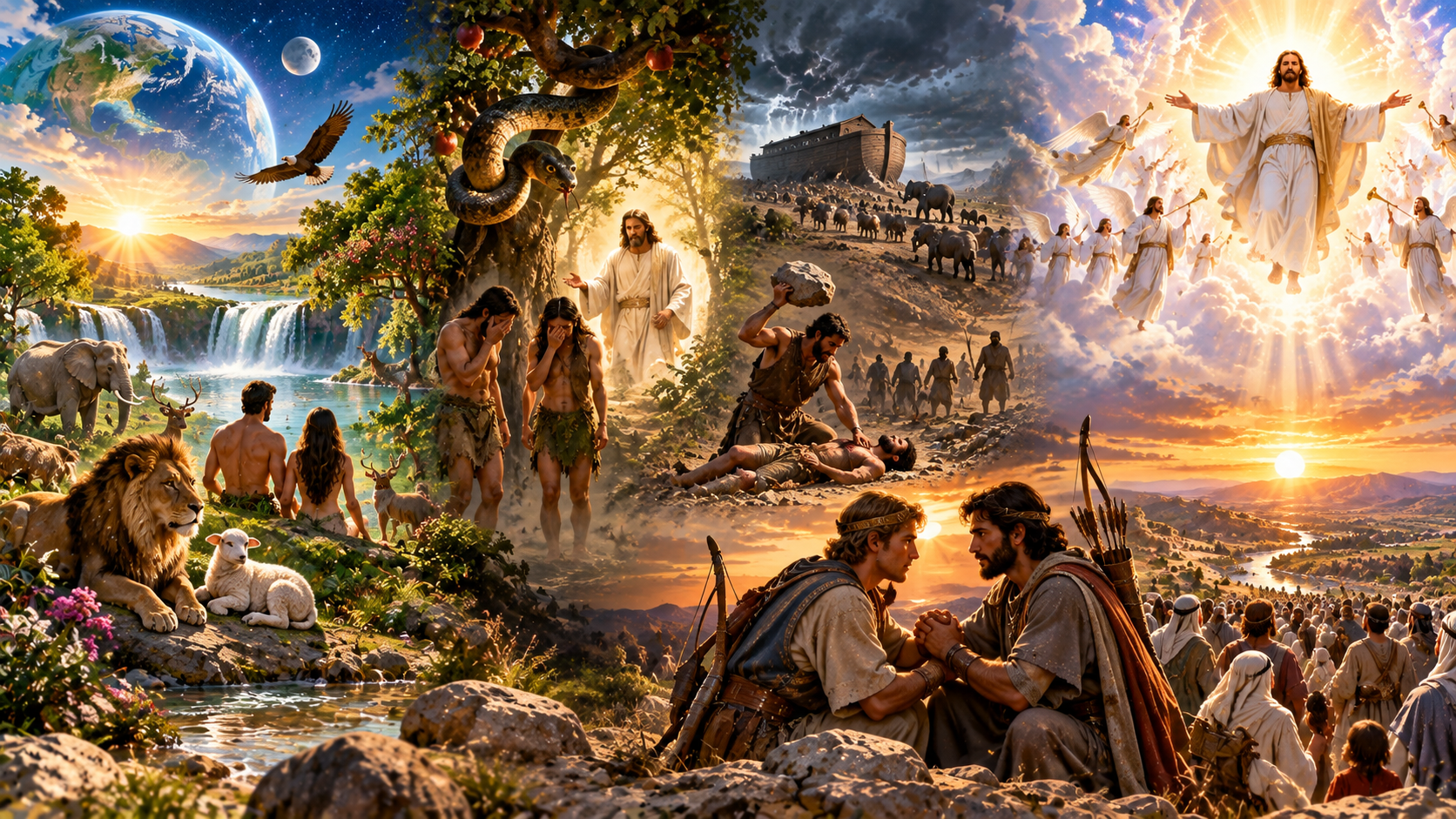
Yeshua in Genesis 1:1–6:8, 1 Samuel 20:18–42, and Matthew 24:29–36
In the Beginning, Yahweh Creates
The Torah begins with perhaps the most familiar words in Scripture: “In the beginning God created the heavens and the earth” (Genesis 1:1). Before Abraham, before Israel, before Moses, before sin, judgment, sacrifice, or covenant, there is Yahweh. And what does Yahweh do? He creates. The Bible begins not with destruction but with creation—not with death but with life. Again and again Yahweh looks upon what He has made and calls it good. When He finishes, He looks upon the whole creation and declares it “very good” (Genesis 1:31). That beginning is important because it tells us something about Yahweh’s intention for His creation before sin ever enters the picture.
The Spirit of Yahweh Hovers Over the Darkness
Genesis tells us that the earth was formless and empty and that darkness was over the surface of the deep, “and the Spirit of God was moving over the surface of the waters” (Genesis 1:2). Darkness is present, but darkness does not frighten Yahweh. Chaos is present, but chaos does not defeat Him. Yahweh speaks into it: “Let there be light.” And there is light. That pattern will repeat throughout Scripture. Yahweh enters darkness and brings light. He enters disorder and brings order. He enters barrenness and brings fruitfulness. He enters death itself and brings life.
Creation Begins With the Word of Yahweh
Genesis 1 repeatedly says, “Then God said.” Yahweh speaks, and creation responds. Light appears. Waters separate. Dry land emerges. Vegetation grows. The heavens are filled with lights. The waters teem with living creatures. Birds fill the sky. Animals walk the earth. Finally humanity appears.
For Believers, it is difficult to read this without remembering John’s description of Yeshua: “In the beginning was the Word” and “All things came into being through Him” (John 1:1–3). Paul likewise says that all things were created through the Son and for Him (Colossians 1:16). Genesis does not yet explain the mystery revealed later in the New Testament, but when Christfollowers look backward through Yeshua (Jesus), we discover that He does not suddenly enter Yahweh’s story at Bethlehem. He was there in the beginning.
Humanity Is Made in Yahweh’s Image
Then Yahweh says, “Let Us make mankind in Our image, according to Our likeness” (Genesis 1:26). Humanity is not introduced as Yahweh’s garbage, His enemy, or something He intends eventually to throw away. Men and women are His image-bearers. Sin will terribly distort that image, but Genesis establishes our identity before it tells us about our fall.
That matters when we think about redemption. Salvation is not Yahweh deciding that creation was a mistake. It is Yahweh restoring what sin (disobeying His Word) has damaged. The Creator has not forgotten what humanity was created to be.
Yahweh Blesses Before Humanity Has Done Anything to Earn It
Genesis 1:28 says, “God blessed them.” Adam and Eve have accomplished nothing. They have built no altar, kept no commandments, offered no sacrifices, and performed no religious works. Their first experience of their Creator is blessing.
Grace, the divine power and ability to walk in His Word, therefore does not suddenly appear in the New Testament. Grace is woven into creation itself. Humanity receives life before it can earn life. Humanity receives the earth before it can deserve the earth. Humanity receives blessing because blessing begins in the heart of the Giver.
Yahweh Rests Because His Creation Is Good
Genesis 2 introduces the seventh day. Yahweh finishes His work and rests. He blesses the seventh day and makes it holy. The biblical story therefore begins with creation moving toward rest. That theme will continue through Scripture. Israel will seek rest in the promised land. Hebrews will speak of a greater Sabbath rest that still remains. Yeshua will invite the weary to come to Him for rest. Creation begins with Yahweh’s rest, and redemption moves toward creation entering fully into the rest of its Creator.
The Serpent Introduces Distrust
Genesis 3 changes everything, but does not catch Yahweh by surprise. The serpent’s first weapon is not physical violence but distrust: “Has God really said…?” The temptation encourages humanity to question Yahweh’s Word and goodness. Adam and Eve begin to suspect that their Creator is withholding something good from them.
That lie continues to haunt humanity. Sin grows when creatures cease trusting the goodness of their Creator. The tragedy of Eden is therefore not simply that somebody ate forbidden fruit. Humanity’s relationship with Yahweh, with one another, and with creation itself is fractured.
Yahweh Comes Looking for the Ones Who Are Hiding
After Adam and Eve sin, they hide. Then comes one of the most revealing questions in Scripture: “Where are you?” (Genesis 3:9). Yahweh knows where Adam is geographically. The question reveals something deeper. Humanity has run from its Creator, but the Creator comes looking for humanity. That pattern reaches beautifully into Yeshua’s ministry: “For the Son of Man has come to seek and to save that which was lost” (Luke 19:10). Genesis begins the story of humanity hiding from Yahweh. The Gospel reveals Yahweh in Yeshua coming to find us.
Judgment Enters Eden, but So Does Hope
Genesis 3 does not minimize sin. Consequences follow. Pain, conflict, toil, and death enter humanity’s experience. Adam and Eve leave the garden. Yet judgment is not the only word spoken. In Genesis 3:15 Yahweh speaks of the woman’s seed ultimately crushing the serpent’s head. Yah’s children have traditionally seen here the first faint announcement of the Gospel—the protoevangelium, the first gospel promise. The serpent wounds, but the serpent will not finally win. The biblical story has barely begun, and already evil has an expiration date.
Yahweh Clothes the Ashamed
Before Adam and Eve leave Eden, Yahweh makes garments for them and clothes them. The people who tried unsuccessfully to cover themselves with fig leaves are covered by Yahweh Himself. Even amid judgment, Yahweh provides. This little scene anticipates a great biblical theme. Human beings cannot finally repair themselves. Yahweh must provide the covering, cleansing, healing, and restoration we need. This is revealed in Romans 13:14 “But put on the Lord Jesus Christ, and make no provision for the flesh in regard to its lusts” and in Ephesians 4:24 “and put on the new self, which in the likeness of God has been created in righteousness and holiness of the truth.”
Cain Shows How Quickly Sin Spreads
Genesis 4 shows the terrible growth of sin. Distrust becomes jealousy. Jealousy becomes hatred. Hatred becomes murder. Cain kills Abel.
Again Yahweh asks a question: “Where is Abel your brother?” Cain answers, “Am I my brother’s keeper?” That question echoes through the Bible. Are we responsible for one another? Isaiah says true worship loosens the bonds of wickedness and feeds the hungry. Yeshua identifies Himself with the hungry, thirsty, stranger, naked, sick, and imprisoned. Cain asks whether he is his brother’s keeper. The Gospel answers that love of neighbor cannot be separated from love of Yahweh.
Even Cain Receives a Mark of Protection
Cain is judged, but Genesis includes a surprising act of mercy. Cain fears that someone will kill him, and Yahweh places a mark upon him so that he will not be slain. Judgment and mercy appear side by side. Yahweh does not declare Cain’s murder unimportant. Neither does He permit vengeance simply to consume Cain. Already Genesis is teaching us that divine judgment is more complex than retaliation.
Death Begins Its Long Reign
Genesis 5 contains a haunting repetition: “and he died.” Adam lived—and he died. Seth lived—and he died. Enosh lived—and he died. Generation follows generation, and the sentence of Eden hangs over humanity.
But one man interrupts the rhythm. Enoch “walked with God; and he was not, for God took him” (Genesis 5:24). Amid a chapter dominated by death, suddenly there is a hint that death may not have the final word. The New Testament will eventually shout what Genesis only whispers: “The last enemy that will be abolished is death” (1 Corinthians 15:26).
By Genesis 6, Creation Has Become Deeply Wounded
Genesis 6 brings us to a grim description of humanity. Wickedness has multiplied, and “every intent of the thoughts of his heart was only evil continually” (Genesis 6:5). The creation Yahweh called “very good” has become filled with corruption and violence, and the Hebrew word translated as violence is hamas/chamas.
But notice Yahweh’s response: He is grieved in His heart. Sin is not merely the violation of an impersonal law. It wounds the heart of the Creator because it destroys creatures He made and loves. Wounded love. Biblical judgment grows out of Yahweh’s opposition to everything that ruins His good creation.
But Noah Found Grace
Genesis 6:8 closes our Torah portion with a little beam of light shining into a dark world: “But Noah found favor in the eyes of Yahweh.” Judgment is approaching, but grace has not disappeared. The Creator has not abandoned His creation. That little word “but” matters. Humanity is violent—but Noah found grace. Darkness spreads—but Yahweh is still working. The story continues.
Jonathan and David Show Us Covenant Faithfulness
The prophetic reading in 1 Samuel 20:18–42 moves us into a very different setting. Saul wants David dead, while Jonathan loves David and has entered into covenant with him. Jonathan devises the signal of the arrows to tell David whether it is safe to return. When the truth becomes clear, Jonathan tells David to flee. The two men weep together and renew their covenant loyalty. The scene is painful because faithfulness sometimes costs something. Jonathan’s loyalty to David places him against the destructive purposes of his own father. Yet covenant faithfulness proves stronger than political convenience.
“Yahweh Will Be Between Me and You Forever”
Jonathan’s farewell contains a beautiful declaration: “Yahweh will be between me and you, and between my descendants and your descendants forever” (1 Samuel 20:42). Genesis has shown relationships breaking apart—Adam blaming Eve, Cain killing Abel, humanity descending into violence. Jonathan and David give us a glimpse of something different: covenant loyalty that refuses to surrender another person simply for self-preservation. It points toward the kind of faithfulness ultimately revealed in Yeshua, who does not abandon His friends when faithfulness becomes costly.
Matthew 24 Turns Our Eyes Toward the Son of Man
Our Gospel reading suddenly expands the horizon. Yeshua speaks of cosmic signs, the coming of the Son of Man, angels, a trumpet, and the gathering of His elect “from the four winds, from one end of the sky to the other” (Matthew 24:31). Genesis began with Yahweh gathering creation out of chaos. Matthew gives us an image of Yeshua gathering His people from their scattering. Creation and gathering belong together.
Sin scatters. Yahweh gathers. Sin alienates. Yahweh reconciles. Sin destroys. Yahweh restores.
The Fig Tree Says the Story Is Moving Somewhere
Yeshua then tells His disciples to learn from the fig tree. When its branch becomes tender and puts forth leaves, they know summer is near. Likewise, the events He describes indicate that Yahweh’s purposes are moving toward fulfillment. Biblical prophecy is therefore not given merely to satisfy curiosity about dates. It calls people to watch, trust, and recognize that history belongs to Yahweh.
“Heaven and Earth Will Pass Away, but My Words Will Not”
Yeshua makes an extraordinary statement: “Heaven and earth will pass away, but My words will not pass away” (Matthew 24:35). Genesis begins with the creation of the heavens and earth. Matthew places before us the enduring authority of Yeshua’s words even beyond the present order of things. The One through whom Christ followers confess creation came into being is also the One whose word stands secure as history moves toward its appointed goal.
No One Knows the Day or Hour
Yeshua immediately warns, “But about that day and hour no one knows” (Matthew 24:36). That should make us cautious about date-setting. The purpose of prophecy is not to provide us with a calculator for predicting Yeshua’s return.
Our calling is faithfulness.
Adam and Eve failed to trust Yahweh’s word. Noah found grace and trusted. Jonathan remained faithful to covenant. Yeshua tells His disciples to remain watchful. Throughout these readings, the central issue is not possessing secret information. It’s trusting Yahweh.
From Creation to Restoration
This is where Acts 3:21 provides a helpful horizon for the whole biblical story. Peter speaks of the “restoration of all things about which God spoke by the mouth of His holy prophets from ancient time.”
What needs restoration? Everything Genesis shows becoming broken.
Humanity’s relationship with Yahweh needs restoration. Human relationships need restoration. Creation itself needs restoration. Violence must end. Death must be defeated. The serpent’s work must be undone. The scattered must be gathered.
The phrase “restoration of all things” is therefore wonderfully appropriate to a Bible whose first chapter tells us where all things came from.
The Creator Is Also the Restorer
Christian universalism sees a profound coherence between Genesis 1 and Acts 3:21. The One who created all things does not cease caring about them when they become broken. Redemption is not Yahweh throwing away His first creation and settling for a tiny surviving fragment. It is the Creator confronting everything that corrupts His handiwork and bringing His purpose to completion.
That does not make judgment unnecessary. Genesis 3–6 makes precisely the opposite point. Evil is too destructive to be ignored. Violence, murder, deception, oppression, and death must be judged because Yahweh loves what they destroy. The universalist hope is not that Yahweh finally tolerates evil. It is that Yahweh finally defeats it.
The Son of Man Gathers What Sin Has Scattered
Matthew 24:31 provides a powerful picture: the Son of Man sends His angels “with a great trumpet blast, and they will gather together His elect from the four winds.” Genesis shows humanity being driven from Eden and increasingly scattered into alienation and violence. The Gospel presents Yeshua as a gatherer. That does not by itself prove universal reconciliation, but it fits the larger biblical movement that reaches toward Peter’s announcement of the restoration of all things. Yahweh’s answer to scattering is gathering. His answer to darkness is light. His answer to death is resurrection.
The Bible Begins With a Good Creation
Before we build our theology around Genesis 3, we should remember Genesis 1.
Creation came before the fall.
Goodness came before sin.
Blessing came before curse.
Life came before death.
Yahweh’s purpose came before humanity’s rebellion.
Sin is an intruder into Yahweh’s good creation. It is not the foundation of creation and need not be its final condition.
The Bible’s Story Is Bigger Than the Fall
Genesis 1:1–6:8 takes us from breathtaking beauty into heartbreaking corruption. But we should not mistake the middle of the story for its ending.
Yahweh created. Humanity rebelled.
Yahweh came looking. The serpent wounded.
Yahweh promised victory. Humanity murdered.
Yahweh restrained vengeance. Death spread.
Enoch provided a whisper of hope. Violence filled the earth.
But Noah found grace.
And eventually Yeshua comes—the One Messiah followers confess was there in the beginning, the One who enters our death and rises from it, the Son of Man who gathers, and the One through whom Yahweh’s purposes for creation reach their fulfillment.
In the Beginning—and in the End
Genesis asks us to look backward: “In the beginning…” Matthew asks us to look forward: “They will see the Son of Man coming…” Acts 3:21 tells us something about the destination: “the restoration of all things.” Put those together and we see a magnificent biblical arc.
The Creator who spoke light into darkness has not surrendered His creation to darkness.
The Father who came looking for Adam has not stopped seeking the lost.
The One who opposed Cain’s violence has not made peace with violence.
The Yahweh who found Noah in a corrupted world has not run out of grace.
The covenant faithfulness reflected in Jonathan’s love for David has not failed.
And Yeshua who promises to gather His people has not lost control of history.
The Bible begins with creation, passes through fall, judgment, covenant, redemption, and resurrection, and points us toward restoration. The first words are: “In the beginning God created the heavens and the earth.” And Peter gives us a beautiful phrase for where the prophetic story is going: “The restoration of all things.”
The One who made all things is not finished with what He made.
Brother Roger
Leave a Reply