
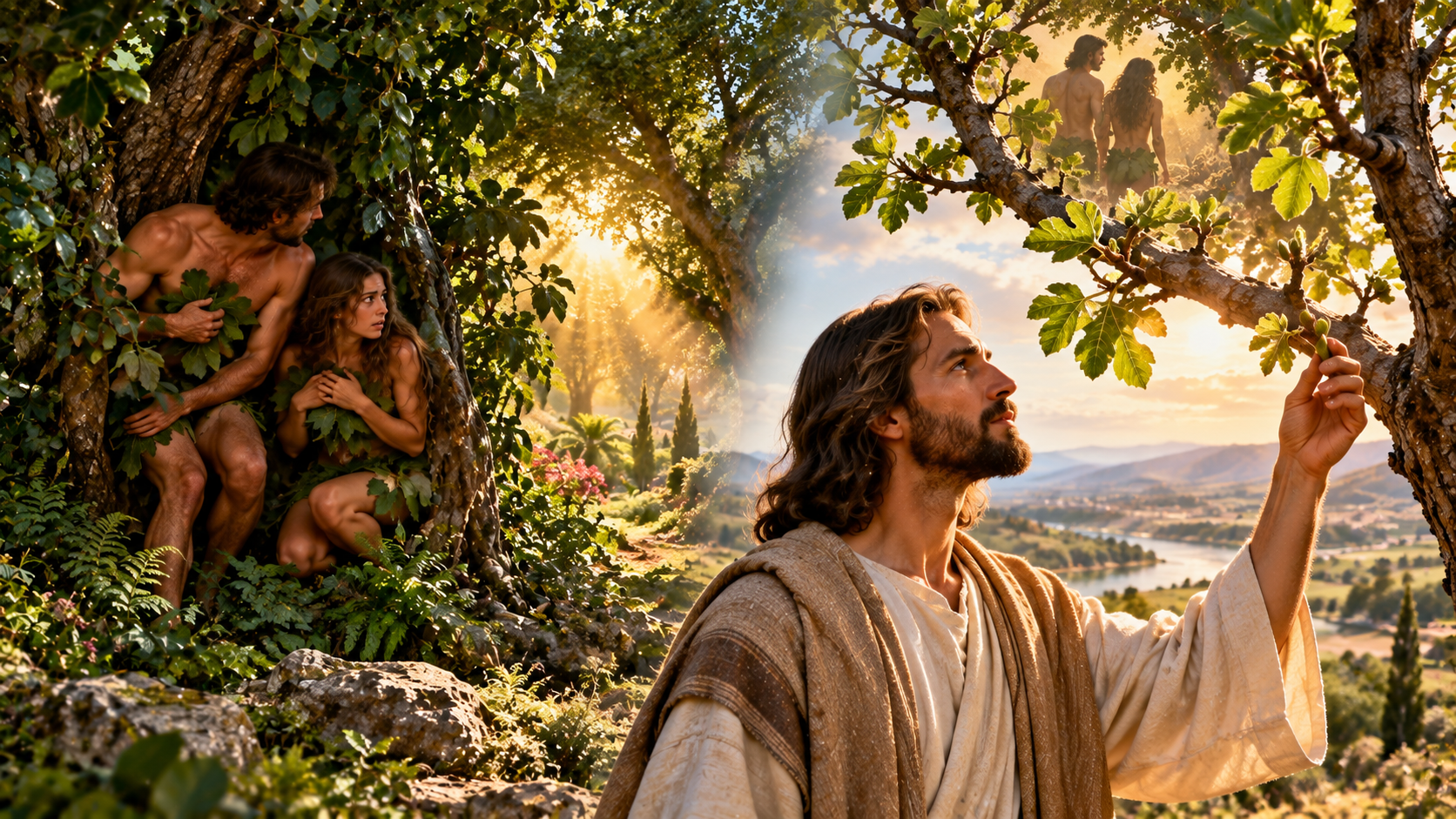
Is there any connection between the fig leaves of Genesis 3:7 and the Matthew 24:32-35 fig tree budding forth its leaves?
Yes, there is a fascinating possible connection between the fig leaves of Genesis 3:7 and the budding fig tree of Matthew 24:32–35. However, we should distinguish between a connection Scripture explicitly makes and a theological connection we can reasonably draw from the larger biblical story. The comparison is especially interesting when viewed through Yeshua’s teaching about the restoration of all things pointed out by Peter in Acts 3:21.
The First Fig Leaves: Humanity Hiding From Yahweh
Genesis 3:7 tells us:
“Then the eyes of both of them were opened, and they knew that they were naked; and they sewed fig leaves together and made themselves waist coverings.”
Before their disobedience, Adam and Eve were naked and unashamed (Genesis 2:25). Afterward, they experienced shame, fear, and alienation. Their first response was to cover themselves with fig leaves. Notice something important: The fig leaves did not solve their problem. They covered their nakedness, but they could not restore their broken fellowship with Yahweh. When Yahweh approached, Adam still hid.
The fig leaves represent humanity’s unsuccessful attempt to deal with the consequences of sin through our efforts. This is a theological interpretation of their action, rather than a meaning Genesis explicitly assigns to the leaves.
The Second Fig Leaves: A Sign That Something Is Coming
Now consider Matthew 24:32–33:
“Now learn the parable from the fig tree: when its branch has already become tender and puts forth its leaves, you know that summer is near; so, you too, when you see all these things, recognize that He is near, right at the door.”
Here, the fig leaves serve a very different purpose. They are not coverings for shame. They are signs of an approaching season. The fig tree has passed through winter. Its branches are becoming tender. New leaves are appearing. Summer is approaching.
Yeshua uses this familiar agricultural observation to teach His disciples that the events He has described indicate the nearness of what He foretold. Importantly, He does not explicitly connect these leaves with the fig leaves of Eden.
An Interesting Contrast Between Genesis and Matthew
Consider the difference:
| Genesis 3:7 | Matthew 24:32–35 |
|---|---|
| Fig leaves appear after disobedience. | Fig leaves appear as summer approaches. |
| Humanity uses leaves to conceal nakedness. | Yeshua uses leaves to reveal the nearness of a season. |
| Adam and Eve experience shame. | Disciples are instructed to recognize the signs. |
| The leaves cannot restore fellowship. | The leaves illustrate the certainty of approaching events. |
| Humanity hides from Yahweh. | Yeshua calls His disciples to watchfulness. |
There is a beautiful literary contrast here.
In Genesis, humanity uses fig leaves to hide. In Matthew, Yeshua uses fig leaves to help humanity see. That is not an explicitly stated biblical typology, but it makes a meaningful illustration.
The Fig Tree and the Restoration of All Things
Acts 3:21 speaks of the restoration of all things foretold by Yahweh’s prophets. The Greek word translated restoration is apokatastasis, referring to restoration or reestablishment. Christ following universalists understand this passage within the broader biblical hope that Yahweh will ultimately overcome everything that has corrupted His creation.
That brings us back to Eden. Genesis describes humanity’s original fellowship with Yahweh and its subsequent rupture through sin. The fig leaves were inadequate to repair that rupture. But the Gospel announces something humanity could never accomplish by sewing leaves together: reconciliation through Yeshua.
Paul writes:
“For as in Adam all die, so also in Christ all will be made alive.” (1 Corinthians 15:22)
Notice the movement. In Adam, death enters humanity’s experience. In Yeshua, resurrection life answers death. The first Adam hides among the trees. The risen Yeshua comes seeking and gathering His people. The first Adam cannot repair what he has broken. The last Adam accomplishes what fallen humanity cannot.
This is a much stronger scriptural connection than treating the two appearances of fig leaves as a deliberate prophecy.
Does the Fig Tree Represent Israel?
There is another question worth considering. In several Old Testament passages, figs and fig trees are associated with Israel, its blessings, or its judgment. For example, Hosea 9:10 compares Yahweh’s early delight in Israel to finding the first fruit on a fig tree. Jeremiah 24 uses baskets of good and bad figs to communicate judgment and hope concerning Judah. Micah 4:4 describes the peace of Yahweh’s coming reign:
“Each of them will sit under his vine and under his fig tree, with no one to make them afraid.”
That last passage is particularly interesting. The fig tree is associated with a future condition of security and peace. However, in Matthew 24, Yeshua does not explicitly identify the budding fig tree as Israel. His immediate point is that leaves announce the approach of summer, just as the events He describes announce the nearness of their fulfillment. Consequently, we should be cautious about interpreting the fig tree as a prediction of a particular modern political event.
Something Else: Yahweh Replaces the Fig Leaves
Genesis 3:21 says:
“And Yahweh God made garments of skin for Adam and his wife, and clothed them.”
This is one of the most tender moments in the early chapters of Genesis. Adam and Eve made coverings for themselves. But Yahweh provided something more substantial. Even after their disobedience, He cared for them. Many believers see this as anticipating the greater provision of redemption through Yeshua. The text itself does not explicitly describe a sacrifice or explain the garments as an atonement, so that connection should be understood as theological foreshadowing. Nevertheless, the contrast is striking. Humanity attempts to cover its shame. Yahweh provides the covering. That is a wonderful picture of mercy and grace.
The Fig Leaves of Eden and the Leaves of the New Creation
There is an even more compelling biblical connection. Revelation 22:2 describes the tree of life in the New Jerusalem:
“And the leaves of the tree were for the healing of the nations.”
Think about that! Genesis 3 begins with humanity using leaves to cover the consequences of disobedience. Revelation 22 concludes with leaves associated with the healing of the nations. The trees are not identified as the same species, and Revelation does not explicitly interpret its leaves as reversing the fig leaves of Genesis. Nevertheless, the literary contrast is remarkable. In Genesis, leaves cover shame. In Revelation, leaves bring healing. And immediately afterward, Revelation 22:3 declares:
“There will no longer be any curse.”
That is particularly significant because Genesis 3 introduced the curse into humanity’s story. The Bible begins with a garden, a tree, disobedience, shame, and alienation. It concludes with a city containing the tree of life, the healing of the nations, and the removal of the curse. The biblical movement from Genesis to Revelation provides a substantial foundation for understanding redemption as the reversal of the fall.
From Hiding to Healing
In Genesis 3, Adam and Eve sewed fig leaves together because they were ashamed. They tried to cover what sin had exposed, but their coverings could not heal their relationship with Father Yahweh. In Matthew 24, Yeshua pointed to the new leaves of a fig tree as a sign that summer was approaching. The leaves were no longer hiding something; they were announcing something. And in Revelation 22, the leaves of the tree of life were for the healing of the nations. Three passages. Three different purposes for leaves.
Covering. Announcing. Healing.
We should not claim that Matthew deliberately establishes this three-part symbolism. But as a meditation on the whole biblical story, it beautifully illustrates the movement from human failure toward Yahweh’s promised restoration.
Conclusion: The Leaves Tell a Bigger Story
We should not argue that the fig leaves in Genesis 3:7 directly predict the budding fig tree in Matthew 24:32. The textual evidence is insufficient to establish that. But we can submit that the two passages offer a meaningful contrast when considered within the larger biblical narrative.
In Eden, humanity attempted to hide the evidence of its brokenness. In Matthew, Yeshua taught His disciples to recognize the signs of approaching fulfillment. In Revelation, the tree of life bears leaves for the healing of the nations. And Acts 3:21 gives us a phrase that describes the larger hope toward which these themes point:
“The restoration of all things.”
In Eden, man reached for leaves to hide his shame. In Matthew, Yeshua pointed to leaves to announce a coming season. And in Revelation, Yahweh provides leaves for the healing of the nations. What began with hiding ends with healing.
That is not a proven prophetic connection between the two fig trees. It is a beautiful and biblically grounded illustration of the Creator’s restorative purpose.
Brother Roger
Leave a Reply