
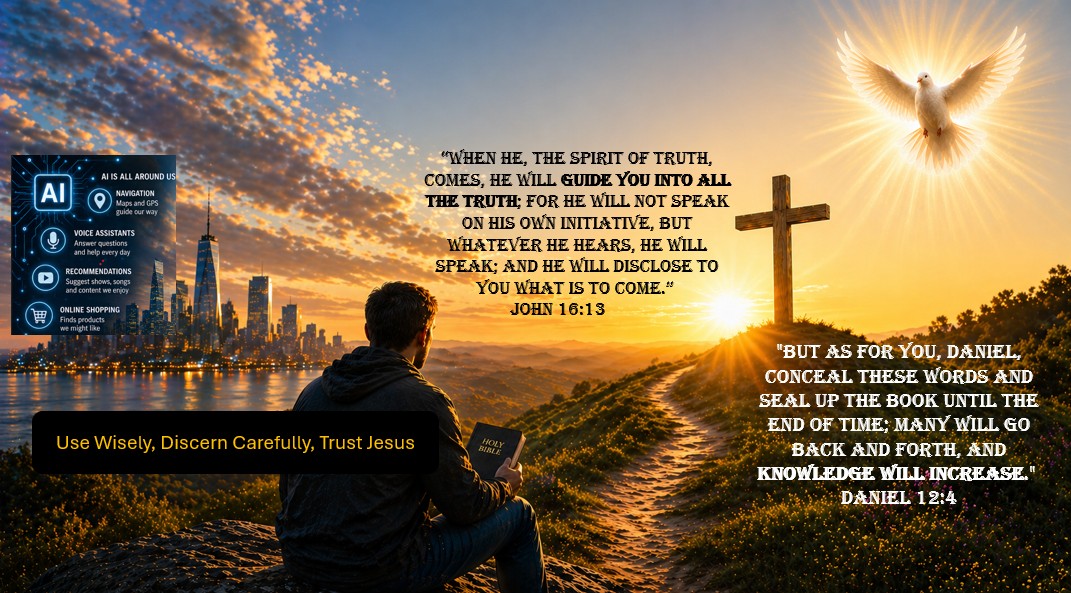
“When He, the Spirit of truth, has come, He will guide you into all truth; for He will not speak on His own authority, but whatever He hears He will speak; and He will tell you things to come.” Jesus, as recorded in John 16:13
I presented the question to my AI program and here is its answer:
“There’s a range of perspectives among Christians on this question, and it depends partly on what specific concerns you have in mind.
Some Christians see AI as a tool that can serve good purposes – much like any technology. From this view, AI can help with healthcare, education, accessibility, and other beneficial applications. The key is using it wisely and ethically, keeping human dignity and well-being at the center.
Others have specific concerns worth considering:
- Questions about human uniqueness and the image of God – what happens when machines seem increasingly human-like?
- Concerns about outsourcing moral reasoning or wisdom to algorithms
- Worries about deception or being misled by AI
- Issues around who controls the technology and for what purposes
- The impact on human work, creativity, and relationships
Many Christian thinkers would suggest a middle path – neither uncritical embrace nor blanket rejection, but thoughtful discernment. This might mean asking questions like: Does this use of AI serve human flourishing? Does it respect human dignity? Am I using it in ways that align with my values? What are the risks and tradeoffs?
Different Christian traditions have varying comfort levels with technology generally – some more cautious, others more optimistic about human innovation as part of our created role as stewards.
What aspects of AI use are you most curious or concerned about? That might help focus the question.”
Brother Roger’s response to AI with my current understanding:
After using AI for a while I am not that concerned about it. Why? We born again Christians are reunited with Jesus and His Holy Spirit. As recorded in John 16:13 Jesus says “When He, the Spirit of truth, has come, He will guide you into all truth; for He will not speak on His own authority, but whatever He hears He will speak; and He will tell you things to come.” Plus, the Apostle Paul in 1 Corinthians 2:10 says “For to us God revealed them through the Spirit; for the Spirit searches all things, even the depths of God. … 2:12 Now we have received, not the spirit of the world, but the Spirit who is from God, so that we may know the things freely given to us by God, … 2:15 But he who is spiritual appraises all things, … 2:16 For who has known the mind of the Lord, that he will instruct Him? But we have the mind of Christ.” Things my change, but this is where I am for now.
Claude AIs response:
“That’s a thoughtful perspective – you’re pointing to the belief that the Holy Spirit provides believers with discernment and guidance, which would naturally include navigating new technologies like AI. If you trust that the Spirit is guiding you “into all truth” and giving you the “mind of Christ,” then the specific tool matters less than the spiritual foundation you’re operating from.
It makes sense that this would reduce anxiety about AI specifically. From that framework, it’s not about fearing the technology itself but about staying connected to that guidance and wisdom you believe you already have access to. I appreciate you sharing where you are on this. It sounds like a grounded place to approach it from.
Examples of AI we all use every day without realizing it
On your phone
- Face or fingerprint unlock on your smartphone uses pattern recognition to verify it is really you.
- Autocorrect and predictive text learn your typing habits to suggest the next word or fix spelling.
- Photo apps group pictures by people, places, or pets using image recognition to spot faces and objects.
- Spam call and spam text detection classify unknown numbers or messages as likely junk.
Online and in apps
- Email spam filters learn what you and others mark as junk and quietly route those messages away.
- Search engines autocomplete your query and rank results based on what people like you tend to click.
- Streaming services (Netflix, YouTube, Spotify) recommend shows, videos, or songs based on what you’ve watched or listened to before.
- Social media feeds use algorithms to decide which posts, ads, and videos to show you first.
Shopping and money
- Online stores suggest “you might also like” products using your past purchases and browsing.
- Credit card companies run every transaction through fraud-detection models that look for unusual spending patterns.
- Loyalty card data at grocery stores is analyzed to decide coupons, promotions, and product placement.
Getting around and planning
- GPS and map apps (like Google Maps or Waze) use real-time data and prediction to give routes, travel times, and traffic warnings.
- Rideshare services estimate arrival times, set dynamic pricing, and match drivers to riders with AI models.
- Weather apps rely on forecast models that use AI techniques to refine local predictions.
At home
- Smart speakers and voice assistants (Alexa, Siri, Google Assistant) recognize speech, remember preferences, and respond more accurately over time.
- Smart thermostats learn your schedule and temperature preferences to heat or cool the house efficiently.
- Smart security cameras distinguish between people, pets, and background motion to avoid false alarms.
Behind the scenes
- Antivirus and security software learn what “normal” behavior on your device looks like and watch for anomalies.
- Many customer-service chats on websites are handled first by AI chatbots that answer common questions.
- Traffic management systems and city infrastructure tools use AI to predict congestion and adjust signals.
Studies in the U.S…. now find that nearly everyone uses several of these AI-powered products each week—navigation apps, streaming, online shopping, social media, weather apps, and assistants—often without realizing they involve AI at all.”
Conclusion
So, for now, Brother Roger is going to use AI, while continuing to seek guidance from the Holy Spirit and use my God-given common sense in this Daniel 12:4 age.
“But as for you, Daniel, conceal these words and seal up the book until the end of time; many will go back and forth, and knowledge will increase.”
Brother Roger
Leave a Reply