
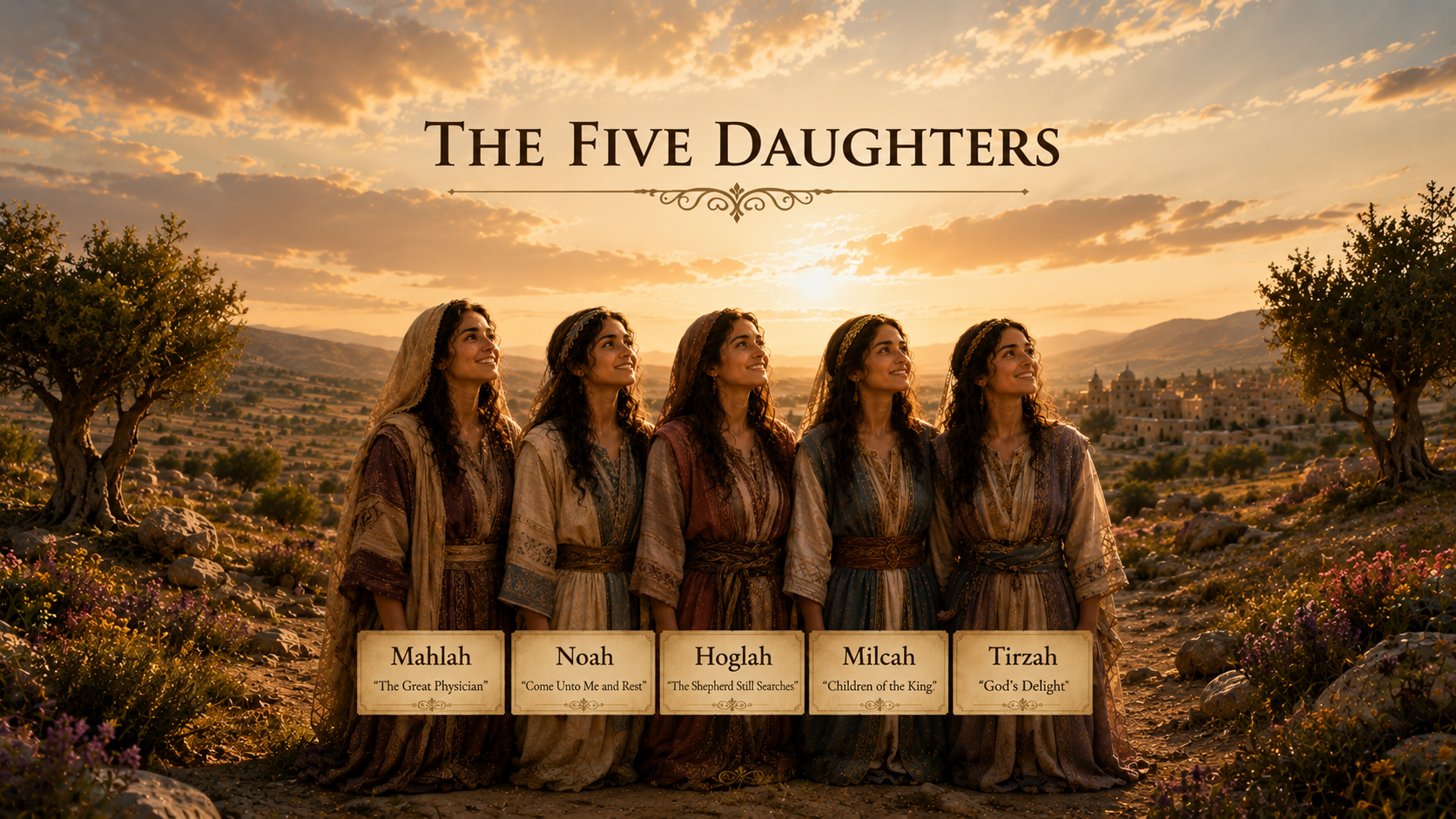
Zelophehad: Their Names, Yeshua, and the Restoration of All Things
Biblical Names Often Carry Theological Meanings
In the Hebrew Scriptures, names frequently convey far more than personal identity. They often reveal character, destiny, divine purpose, or prophetic truth. While Scripture itself does not explicitly state that the names of Zelophehad’s (zih-LOH-fuh-had) five daughters form a prophetic message, the meanings of their names are sufficiently rich that many students of Scripture have seen beautiful spiritual lessons within them. Since Yeshua taught that Moses wrote concerning Him (Luke 24:27; John 5:46), it is appropriate to ask whether these remarkable women—and even their names—may foreshadow aspects of His redemptive work. Likewise, because Peter declared in Acts 3:21 that the prophets spoke of the coming “restoration of all things,” we may ask whether their story harmonizes with Yahweh’s larger plan of restoration.
The Remarkable Faith of the Five Sisters
Unlike many narratives in the Torah, these women are named individually. They boldly approach Moses, Eleazar the priest, the tribal leaders, and the whole congregation to seek justice. Rather than rebuking them, Yahweh Himself affirms their request and permanently changes Israel’s inheritance laws. Their story demonstrates that Yahweh delights in righteous faith and that His justice is compassionate rather than rigid. Their appeal becomes one of the clearest demonstrations in the Torah that Yahweh’s covenant blessings are intended to include those who appear to stand outside traditional expectations.
Mahlah — “Sickness,” “Weakness,” or “One Who Is Infirm”
The Hebrew name Mahlah (מַחְלָה) is generally derived from the root alah, meaning “to become sick,” “to be weak,” or “to be afflicted.”
At first glance, this seems an unusual name. Yet throughout Scripture, sickness often symbolizes humanity’s fallen condition. Isaiah describes mankind as spiritually diseased from head to foot, and Yeshua repeatedly compares sinners to those needing a physician. If Mahlah represents humanity’s weakness, she beautifully foreshadows those whom Yeshua came to heal. His mission was directed toward the spiritually sick. Universal restoration likewise begins with the recognition that all humanity shares the same sickness of sin and therefore stands equally in need of the Great Physician.
Noah — “Rest,” “Comfort,” or “Peace”
The second daughter bears the feminine form of Noah (נֹעָה), which is related to the idea of rest, repose, or peaceful movement. Although distinct from the masculine Noah (Noach), both names carry themes of rest and comfort.
Yeshua repeatedly invites weary humanity to enter His rest: “Come unto Me, all who labor and are heavy laden, and I will give you rest.” The inheritance sought by Noah ultimately points beyond land toward the greater rest found in Messiah. Hebrews teaches that Joshua’s conquest did not exhaust Yahweh’s promise of rest; the true Sabbath remains fulfilled in Yeshua Himself.
Within a universal restoration framework, this name anticipates the day when all creation finally enters Yahweh’s Sabbath peace.
Hoglah — “Partridge”
Hoglah (חָגְלָה) is usually understood to mean “partridge,” a bird well known throughout the ancient Near East. The partridge appears only a few times in Scripture. In Jeremiah 17:11 it becomes a picture of misplaced possession, while David compares himself to a hunted partridge fleeing through the mountains (1 Samuel 26:20). Thus Hoglah may symbolize vulnerability, wandering, or those pursued and scattered.
Yeshua repeatedly identifies Himself as the Shepherd seeking scattered sheep. He comes specifically to gather those who have wandered far from home. Universal restoration likewise sees the Good Shepherd refusing to abandon the lost of His flock until every wandering sheep has been found.
Milcah — “Queen,” “Royal One,” or “Counsel”
The name Milcah (מִלְכָּה) comes from the Hebrew root melek, meaning “king.” Accordingly, Milcah is generally translated “queen,” “royal woman,” or one possessing royal dignity. This name beautifully reflects the believer’s current and future inheritance. Through Yeshua, redeemed humanity becomes “a kingdom of priests”, Exodus 19:6 and 1 Peter 2:9. Scripture consistently teaches that Yahweh’s purpose is not merely forgiveness but restoration to royal fellowship with Himself.
Universal restoration likewise emphasizes that humanity was created to bear Yahweh’s image and exercise righteous dominion. Redemption restores what sin damaged rather than merely rescuing individuals from punishment.
Tirzah — “Delight,” “Pleasure,” “Beauty,” or “She Is Acceptable”
Perhaps the most beautiful of the five names is Tirzah (תִּרְצָה), usually translated “delight,” “pleasantness,” “beauty,” or “one who is pleasing.” The name comes from the Hebrew root ratsah, meaning “to delight in,” “to accept,” or “to find pleasure.” This language closely parallels many Old Testament passages describing Yahweh’s acceptance of sacrifices and His delight in His people. Through Yeshua, believers become accepted before Yahweh—not because of personal merit but because of His righteousness.
Universal restoration often emphasizes this same theme. Yahweh’s ultimate purpose is not perpetual rejection but eventual acceptance and reconciliation. The New Testament repeatedly declares that Yahweh delights in mercy and that His purpose is reconciliation through Messiah.
Together the Five Names Tell a Beautiful Story
Although Scripture never explicitly states that the names form a prophetic sentence, many commentators have noticed how naturally they fit together. One possible devotional reading might be:
Humanity begins in weakness (Mahlah).
Yeshua brings rest (Noah).
He seeks the wandering (Hoglah).
He restores them to royal dignity (Milcah).
They become Yahweh’s delight (Tirzah).
Whether or not Moses consciously intended such a progression, the sequence harmonizes remarkably well with the overall Biblical narrative of redemption.
Their Appeal for an Inheritance Points Directly to Yeshua
The central issue in Numbers 27 is inheritance. These women seek not wealth alone but participation in Yahweh’s covenant promises. Their request anticipates the New Testament declaration that believers become fellow heirs with Messiah. Yeshua secures the inheritance that Adam forfeited. What these sisters sought within Canaan becomes a picture of the greater inheritance prepared for all who belong to Messiah.
Yahweh’s Expanding Inheritance Reflects His Expanding Mercy and Grace
Yahweh does not simply answer the sisters’ request. He permanently enlarges Israel’s inheritance law so that others in similar situations may also receive justice. This is precisely how grace unfolds throughout Scripture. Yahweh’s blessings continually expand outward:
from Abraham’s family,
to Israel,
to the Gentiles,
to every tribe and nation,
and ultimately, according to the Victorious Gospel hope, toward the reconciliation of all creation. 1 Corinthians 15:28. The story moves consistently toward inclusion rather than exclusion.
Universal Restoration Foreshadowed in Their Story
Acts 3:21 declares that Yeshua remains in heaven until “the restoration of all things” spoken by the prophets. The story of Zelophehad’s daughters beautifully reflects that restorative pattern.
Instead of exclusion, there is inclusion.
Instead of loss, there is inheritance.
Instead of silence, there is a hearing.
Instead of injustice, there is righteousness.
Instead of limitation, there is expansion.
Instead of disappointment, there is delight.
These movements are entirely consistent with the larger biblical pattern that Yahweh’s judgments ultimately serve His restorative purposes for all.
From Weakness to Delight Through Yeshua
When viewed through the lens of Luke 24:27, the daughters of Zelophehad become far more than participants in an ancient legal case. Their names, their faith, and their inheritance together form a beautiful portrait of the Victorious Gospel. Humanity begins weak like Mahlah. Yeshua offers the true rest pictured by Noah. He seeks wandering people represented by Hoglah. He restores them to royal dignity like Milcah. Finally, through His finished work, they become Yahweh’s accepted delight, beautifully reflected in Tirzah. Whether understood as intentional prophecy or as providential foreshadowing, the story harmonizes wonderfully with Peter’s vision in Acts 3:21. The eternal Father who expanded an inheritance for five faithful sisters is the same Yahweh who, through Yeshua, is bringing history toward the restoration of all things, so that His mercy, justice, and covenant promises may reach their glorious fulfillment.
Brother Roger
Enjoy the five confirming songs:
PS: Is there anything along the same lines hidden in the names of the six ancestors of these five daughters: Zelophehad (rupture or firstborn), the son of Hepher (a pit, possibly meaning to dig, search out), the son of Gilead (a heap of testimony, or possibly a perpetual fountain), the son of Machir (salesman, possibly to give or surrender oneself), the son of Manasseh (forget), the son of Joseph (He shall add)? Yes. Click below to be blessed as you experience a Proverbs 25:2 revelation.
thefallacyofhell.com/2026/07/07/torah-portion-numbers-27-six-ancestors-of-the-five-daughters/
Leave a Reply