
A Hidden Portrait of Yeshua and the Restoration of All Things.
Reading Biblical Genealogies Through the Lens of Yeshua
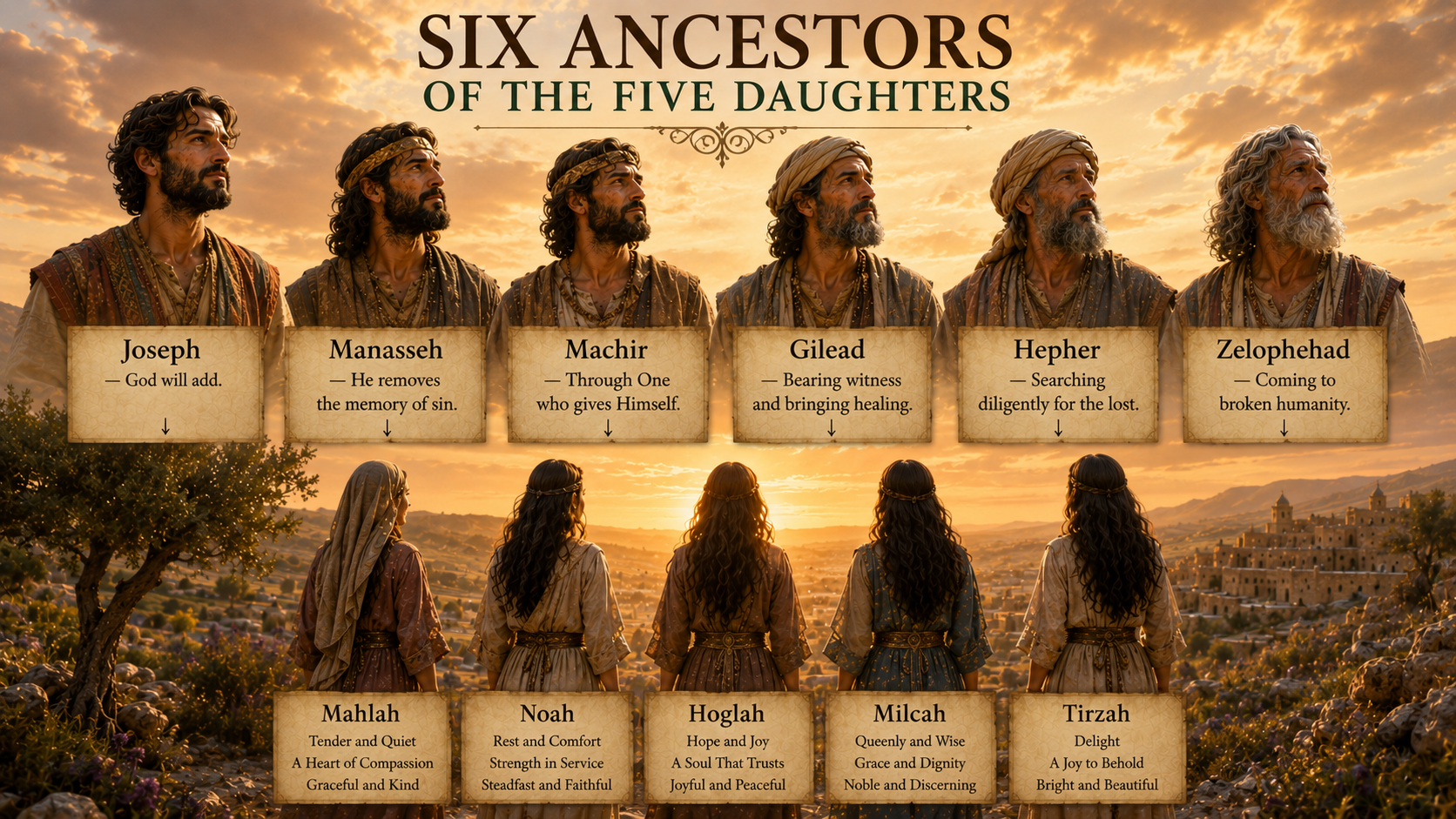
Biblical genealogies often appear to modern readers as little more than lists of names, yet throughout Scripture names frequently carry theological significance. They reveal character, destiny, covenant purpose, and sometimes profound prophetic symbolism. While the Bible does not explicitly state that the genealogy of Zelophehad (zih-LOH-fuh-had) forms a hidden prophecy of Yeshua, His own words invite us to look more deeply. Yeshua declared that Moses wrote concerning Him (John 5:46), and after His resurrection He explained to the disciples “the things concerning Himself in all the Scriptures” (Luke 24:27). This encourages us to examine even genealogies for patterns that illuminate Yahweh’s redemptive plan. Such observations should be understood as devotional and typological rather than explicit doctrine, but they can nevertheless enrich our appreciation of the remarkable unity of Scripture.
An especially intriguing observation comes from E. W. Bullinger in Number in Scripture. Bullinger associates the number six with mankind, since humanity was created on the sixth day, while five represents divine grace. In the genealogy of Zelophehad we find six generations of men culminating in five daughters whose story becomes one of grace, expanded inheritance, and divine inclusion. Whether intentional or providential, this progression provides a striking framework through which to view the Victorious Gospel.
Joseph: “He Shall Add”
The genealogy begins with Joseph, whose Hebrew name, Yosef, means “He shall add” or “May Yahweh add.” Joseph is one of the clearest Old Testament types of Yeshua. He was beloved by his father, rejected by his brothers, sold for silver, falsely accused, humbled before being exalted, and ultimately became the means of salvation not only for Israel but also for the surrounding nations. His story consistently moves from rejection to reconciliation.
Beginning this genealogy with Joseph immediately places it within one of Scripture’s greatest Messianic narratives. From the perspective of universal restoration, Joseph is particularly significant because his wisdom preserved not only his own family but also Egypt and many neighboring peoples from famine. His life demonstrates that God’s redemptive purposes extend far beyond a single nation and that reconciliation ultimately triumphs over judgment.
Manasseh: Forgetting the Former Things
Joseph’s son Manasseh derives his name from the Hebrew verb meaning “to forget” or “to cause to forget.” Joseph explained that Yahweh had caused him to forget the hardships of his earlier life. On a deeper theological level, this name anticipates Yahweh’s promise to remove the remembrance of sin. Through the prophets, Yahweh declares that He will remember His people’s sins no more. The New Covenant fulfills this promise through Yeshua, whose sacrifice removes guilt rather than merely covering it.
Within the broader hope of universal restoration, Manasseh points toward the day when sin no longer defines humanity’s relationship with Father Yahweh. Rather than eternally remembering mankind’s rebellion, Yah promises complete forgiveness and lasting reconciliation.
Machir: The One Who Gives Himself
The name Machir is generally connected with the Hebrew verb makar, meaning “to sell.” Some scholars also recognize the broader idea of transferring or giving over. Although the exact nuance remains uncertain, the concept naturally recalls the self-giving nature of Yeshua. Isaiah foretold that the Messiah would pour out Himself unto death, while Paul explains that Yeshua emptied Himself and took the form of a servant. Redemption is accomplished not through coercion but through willing self-sacrifice. Read typologically, Machir reminds us that Yahweh’s salvation comes through One who freely surrendered Himself for the life of the world.
Gilead: The Heap of Testimony and Healing
Gilead literally means “heap of testimony” or “heap of witness,” recalling the covenant memorial established by Jacob and Laban. Throughout Scripture, testimony bears witness to Yahweh’s faithfulness and His covenant promises. Yeshua is Himself called the faithful and true Witness, perfectly revealing the Father’s character to the world.
Many students of Scripture also associate Gilead with healing because of the famous “balm of Gilead” mentioned by Jeremiah. The prophet’s question, “Is there no balm in Gilead?” has long been understood by Christians as pointing ultimately to Yeshua, the true Healer of humanity’s deepest wounds. This beautifully harmonizes with Acts 3:21, which looks forward to the restoration of all things through the Messiah.
Hepher: Searching for the Lost
The name Hepher is generally understood to come from a Hebrew root meaning “to dig” or “to search out.” Throughout the Scriptures, searching often symbolizes Yah’s persistent pursuit of His people. The Psalms describe Yahweh searching the human heart, while the prophets speak of His intimate knowledge of every person.
Yeshua repeatedly portrays Himself as the Shepherd who searches until He finds the lost sheep, the woman who searches diligently for the lost coin, and the Father who eagerly receives the returning son. Seen in this light, Hepher beautifully foreshadows the divine determination to seek and restore what has been lost rather than abandon it forever.
Zelophehad: Humanity’s Brokenness
The meaning of Zelophehad remains one of the more debated names in the Hebrew Bible. Various suggestions include “firstborn of rupture,” “breaking open,” “shadow from fear,” or “protection from fear.” While certainty is impossible, each proposed meaning fits remarkably well within the broader biblical story. If the name emphasizes rupture or brokenness, it reflects the fractured condition of humanity under sin. Creation itself groans, relationships are broken, and mankind lives under the consequences of rebellion. If the name instead emphasizes protection from fear, it anticipates the repeated words of Yah: “Do not fear and fear not” In either case, the name points toward humanity’s profound need for the restoration that only the Messiah can accomplish.
Five Daughters: Divine Grace Appears
At this point the genealogy takes an unexpected turn. Instead of continuing through another male heir, Scripture introduces five daughters: Mahlah, Noah, Hoglah, Milcah, and Tirzah. Here Bullinger’s observation regarding the symbolism of the number five becomes especially meaningful. If five represents divine grace, then the genealogy reaches its climax not merely in another generation but in grace itself.
These women approach Moses with remarkable faith, seeking an inheritance that the existing law did not explicitly provide. Yahweh not only grants their request but permanently enlarges Israel’s inheritance laws so that others in similar circumstances might also receive justice. Instead of exclusion there is inclusion. Instead of limitation there is expansion. Instead of loss there is inheritance. This movement beautifully anticipates the ministry of Yeshua, whose grace continually enlarges the family of our Creator Redeemer Father.
The Genealogy as a Devotional Portrait of the Gospel
When read devotionally, the sequence of names forms a striking progression. Joseph reminds us that Yahweh adds to His people. Manasseh speaks of forgotten sins. Machir points toward the One who willingly gives Himself. Gilead bears witness to Yah’s healing grace. Hepher reflects Yeshua’s search for the lost. Zelophehad portrays humanity’s broken condition. Finally, the five daughters demonstrate the triumph of divine grace through an expanded inheritance.
While we should avoid claiming that Moses consciously intended this exact sequence as prophecy, the progression harmonizes remarkably well with the unfolding story of redemption revealed throughout the rest of Scripture.
Six Men Leading to Five Women
Bullinger’s numerical observations add another fascinating dimension to the passage. Six named male ancestors precede the appearance of five daughters. If six symbolizes mankind and five symbolizes divine grace, the genealogy presents an elegant theological picture: humanity’s long history ultimately arrives at Yahweh’s grace.
This pattern echoes Paul’s declaration in Romans that where sin increased, grace abounded all the more. Human effort reaches its limit, but divine grace accomplishes what mankind never could. The genealogy thus becomes an illustration of Yahweh’s redemptive movement from fallen humanity toward gracious restoration.
The Expanded Inheritance Foreshadows the Restoration of All Things
Perhaps the most significant feature of this account is not simply the meanings of the names but the outcome of the narrative itself. Because of the faith of these five women, Yahweh’s inheritance law is permanently expanded. The circle of blessing grows larger rather than smaller. No one loses an inheritance because these women receive one; instead, Yahweh’s justice extends to include those previously overlooked.
This pattern closely resembles the ministry of Yeshua. Throughout the Gospels He continually enlarges the covenant community. Women are honored. Children are welcomed. Gentiles are included. Tax collectors, prostitutes and sinners are forgiven. Enemies are offered reconciliation. The movement of redemption consistently expands rather than contracts.
Read alongside Peter’s declaration in Acts 3:21, the story points toward Yah’s ultimate purpose of restoring all things. Just as the inheritance laws were enlarged rather than diminished, so the work of Yeshua reveals our Creator’s intention to bring His creation into its fullest inheritance through His powerful grace.
Conclusion: From Humanity to Grace Through Yeshua
Whether viewed as intentional prophecy or providential typology, the genealogy of Zelophehad presents a remarkably Gospel-shaped progression. Beginning with Joseph, one of Scripture’s greatest pictures of the Messiah, it unfolds through themes of addition, forgiveness, self-giving, testimony, searching, brokenness, and finally divine grace. The six generations of mankind culminate in five daughters whose story transforms Israel’s inheritance law and reveals the compassionate heart of our Father.
Seen through the light of Luke 24:27 and Acts 3:21, this genealogy harmonizes beautifully with the mission of Yeshua. Yahweh adds to His family, forgets forgiven sin, gives Himself in sacrificial love, bears faithful witness, searches for the lost, enters humanity’s brokenness, and finally extends His grace through an ever-expanding inheritance. The result is a compelling illustration of Yahweh’s unwavering purpose to restore all things through His Son, in whom every promise finds its perfect fulfillment.
Brother Roger
Leave a Reply