
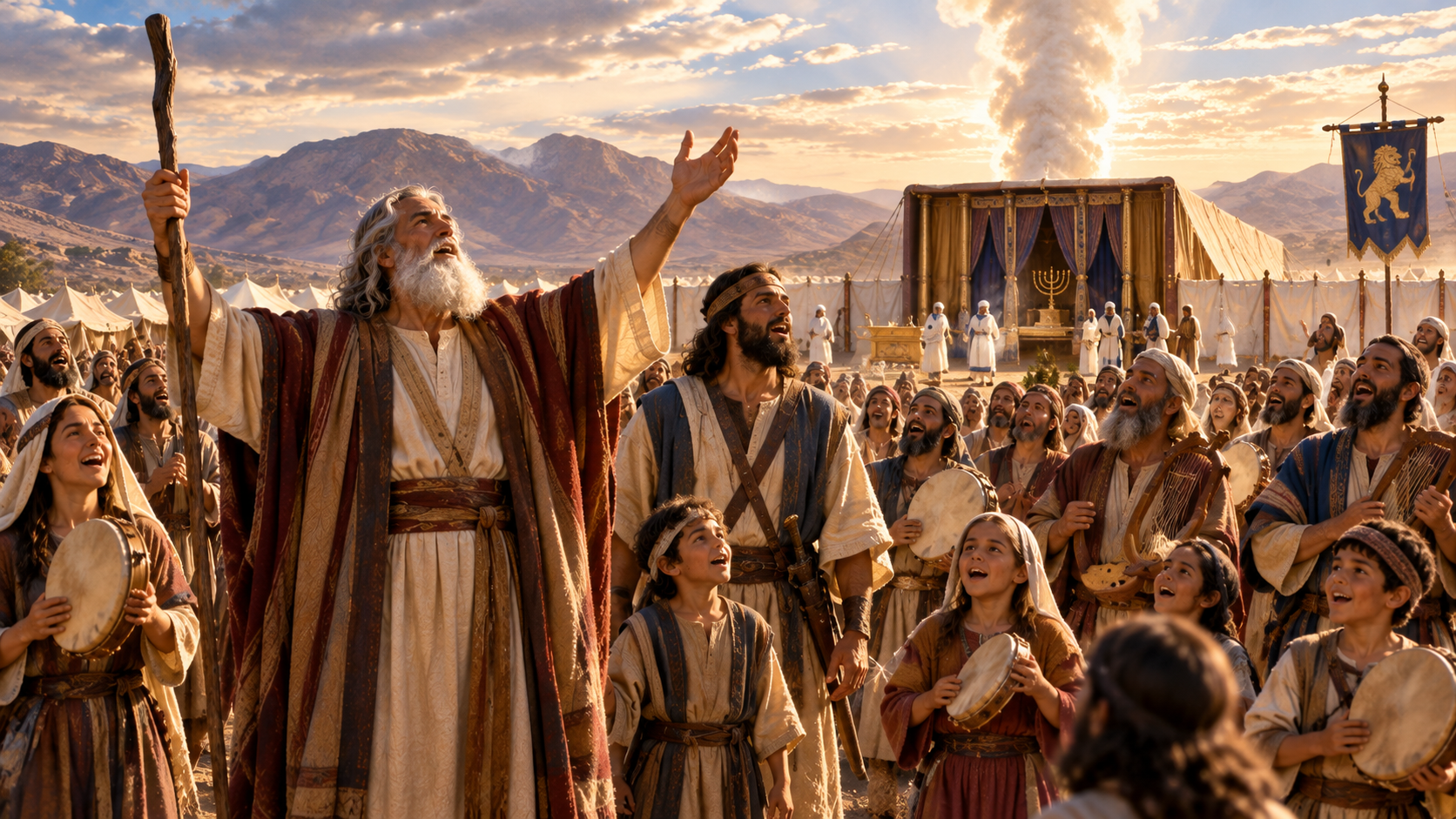
Song of Moses
TORAH: Deuteronomy 32:1–52
PROPHETS: Hosea 14:2–10; Joel 2:15–27
GOSPEL: Matthew 18:21–35
At first glance, Deuteronomy 32, Hosea 14, Joel 2, and Matthew 18 may appear to address very different subjects. Moses sings about Israel’s rebellion and Yahweh’s judgment. Hosea pleads with Israel to return to Yahweh. Joel calls a devastated nation to repentance and promises restoration. Yeshua tells Peter that forgiveness must extend far beyond what he imagined and then tells the parable of the unforgiving servant. Yet when these passages are placed beside one another, a common pattern emerges: humanity wanders, Yahweh confronts sin, judgment exposes what has gone wrong, mercy calls the sinner home, and restoration follows.
This pattern becomes particularly significant when we remember two New Testament statements about Yeshua. Yeshua said, “Truly, truly, I say to you, before Abraham was, I am” (John 8:58). Peter later spoke of Yeshua “whom heaven must receive until the period of restoration of all things about which God spoke by the mouth of His holy prophets from ancient time” (Acts 3:21). These statements encourage Believers to read Torah and the Prophets not as an abandoned religious system belonging to somebody else, but as the beginning of the same redemptive story that reaches its fulfillment in Yeshua.
The Song Begins With the Character of Yahweh
Deuteronomy 32 begins with Moses summoning heaven and earth to listen. His teaching is to fall “as the rain” and “as the dew” upon tender vegetation. Before Moses describes Israel’s terrible rebellion, he establishes the character of Yahweh: “The Rock! His work is perfect, for all His ways are just; a God of faithfulness and without injustice, righteous and upright is He” (Deuteronomy 32:4).
That statement is important because everything that follows must be interpreted in light of it. Yahweh judges Israel, but He remains faithful. His anger does not transform Him into something contrary to His character. He remains righteous, just, and faithful.
For followers of the Messiah, the repeated description of Yahweh as “the Rock” has an additional resonance. Paul later looks back upon Israel’s wilderness experience and writes, “the rock was Messiah” (1 Corinthians 10:4). We should not therefore turn every occurrence of “Rock” in Deuteronomy 32 into a direct prediction of Yeshua. Nevertheless, Paul clearly understood Israel’s wilderness story as possessing a Messianic dimension.
Before Abraham Was, I Am
This becomes even more striking when placed beside Yeshua’s words in John 8:58: “Before Abraham was, I am.” Whatever debates surround the precise relationship of this statement to the divine name in Exodus, John plainly portrays Yeshua as claiming existence prior to Abraham, not merely beginning His existence at Bethlehem.
That means the story of Yeshua cannot simply begin in a manger. Before Bethlehem was Abraham, and before Abraham was Yeshua. When Believers therefore read Moses describing the faithful Rock, the One who creates, sustains, carries, judges, heals, saves, and gives life, we are reading the Scriptures that prepared the world to understand who Yeshua is.
Yeshua did not suddenly appear as an afterthought in the biblical story. The Gospel reveals the One toward whom the story had long been moving.
The Father Who Made Them
Moses asks rebellious Israel, “Is not He your Father who has bought you? He has made you and established you” (Deuteronomy 32:6). This is important because the severe judgments later in the song come from One who has already identified Himself as their Father.
Israel’s sin is therefore not merely lawbreaking. It is relational betrayal. The children have forgotten their Father. Yet their rebellion does not cause Yahweh to cease being the One who made them. Moses remembers how Yahweh “found him in a desert land” and “guarded him as the pupil of His eye” (Deuteronomy 32:10). Like an eagle hovering over its young, Yahweh spread His wings, caught Israel, and carried His people.
This tender picture belongs in the same chapter as the severe judgment passages. The Judge is also the Father. The One who disciplines is the One who carried them. That prepares us to understand Yeshua, who reveals Yahweh as Father and describes Himself as the Shepherd who searches for the lost.
Israel Forgets the Rock
The tragedy comes when Israel prospers and forgets the source of its blessings. Moses says that Jeshurun (meaning upright) “forsook God who made him, and scorned the Rock of his salvation” (Deuteronomy 32:15). Then Moses says, “You neglected the Rock who begot you, and forgot the God who gave you birth” (Deuteronomy 32:18).
This is the heart of sin in the Song of Moses. Israel exchanges the true Rock for false gods. The false gods promise life but cannot provide it. They promise security but cannot save. Eventually Yahweh asks where those gods have gone: “Where are their gods, the rock in which they sought refuge?” (Deuteronomy 32:37).
Judgment exposes false saviors. That principle remains relevant in the Gospel. Whatever we trust instead of Yahweh eventually reveals its limitations. Money, power, religious status, human strength, political power, and personal achievement cannot finally conquer sin and death. Only the true Rock can do that.
Judgment Is Real, but Keep Reading
Deuteronomy 32 contains frightening language of judgment. Yahweh does not treat Israel’s idolatry as insignificant. There are consequences for rebellion. A theology of restoration should never solve this difficulty by pretending these passages are not there. Biblical universal restoration, if true, cannot mean that sin does not matter or that judgment is imaginary.
But neither should we stop reading the Song of Moses in the middle, because the song changes direction. When Israel’s strength is gone and its false gods have proved helpless, Deuteronomy 32:36 says that Yahweh “will vindicate His people, and will have compassion on His servants.” Judgment has not caused Yahweh to abandon His people. Compassion remains.
“I Kill, and I Make Alive”
Then comes one of the most important statements in the Song of Moses: “See now that I, I am He, and there is no god besides Me; it is I who put to death and give life. I have wounded and it is I who heal” (Deuteronomy 32:39).
Notice the movement: Yahweh puts to death—and gives life. Yahweh wounds—and heals. The wounding is real, but so is the healing. Death is real, but death does not lie beyond Yahweh’s authority. This becomes enormously important when considered alongside Yeshua. The Gospel does not deny death. Yeshua Himself enters death. Yet resurrection demonstrates that death cannot finally frustrate Yahweh’s purposes. The God of Moses declares, “I give life,” and the Gospel shows us an empty tomb.
Hosea Says, “Return”
That brings us naturally to Hosea 14. Israel has again wandered from Yahweh, but the prophetic message does not end with abandonment. Hosea cries, “Return, O Israel, to Yahweh your God, for you have stumbled because of your iniquity” (Hosea 14:1).
Notice the word return. Yahweh does not say, “You stumbled, therefore remain away forever.” He calls them home. Israel is instructed to bring words of repentance and ask Yahweh to remove iniquity. Then comes Yahweh’s magnificent response: “I will heal their apostasy, I will love them freely” (Hosea 14:4). There is that word again: heal. Moses said, “I have wounded and it is I who heal.” Hosea says, “I will heal their apostasy.” The prophetic story is developing along the trajectory already established in Torah.
Yahweh Heals the Sin, Not Merely the Consequences
Hosea’s promise is particularly beautiful because Yahweh does not merely promise to improve Israel’s circumstances. He promises to heal their apostasy—the very condition that caused their wandering. This is deeper than external rescue. The disease itself is treated.
From a restoration perspective, this is tremendously important. Yahweh’s solution to rebellious creatures is not merely separation from them. He declares Himself capable of healing rebellion. “I will love them freely,” He says. The sinner returns because Yahweh has opened the road home.
Israel Becomes Fruitful Again
Hosea then changes from medical imagery to agricultural imagery. Yahweh will be like dew to Israel. Israel will blossom like the lily, take root, spread out, become beautiful like the olive tree, and fragrant like Lebanon.
Judgment had produced barrenness, but restoration produces fruitfulness. The final image is particularly striking: “From Me comes your fruit” (Hosea 14:8). Israel’s restoration does not ultimately originate in Israel’s strength; it comes from Yahweh.This harmonizes beautifully with Acts 3:21. If the prophets spoke from ancient times about the restoration of all things, Hosea gives us one example of what restoration looks like: the rebellious are called home, apostasy is healed, love is freely given, and what had become barren bears fruit again.
Joel Sounds the Trumpet
Joel 2 begins this portion with another call: “Blow a trumpet in Zion, consecrate a fast, proclaim a solemn assembly” (Joel 2:15). Everyone is summoned—the elders, the children, and even nursing infants. The bridegroom leaves his room and the bride her chamber. The priests weep before Yahweh and plead for mercy. The entire community stands before Him.
Again we see that biblical judgment is intended to provoke a response. Yahweh confronts His people because something has gone terribly wrong. But judgment is not where Joel ends.
Yahweh Becomes Zealous for His Land
Joel then tells us, “Then Yahweh will be zealous for His land and will have pity on His people” (Joel 2:18). There is the pattern again: warning, repentance, pity, and restoration.
Yahweh promises grain, new wine, and oil. The invading enemy is removed, and the land is told not to fear but to rejoice. Even the animals are told not to fear because the pastures will become green again. This is not merely spiritual restoration floating somewhere in heaven. Joel pictures Yahweh restoring the physical world His people inhabit. Fields matter. Animals matter. Rain matters. Food matters. Land matters. Creation matters. That gives Acts 3:21—the “restoration of all things”—a wonderfully earthy background.
“I Will Make Up to You for the Years”
Then Joel gives one of the most beloved restoration promises in Scripture: “Then I will make up to you for the years that the swarming locust has eaten” (Joel 2:25).
What a remarkable description of Yahweh. He does not merely stop the destruction; He restores what was lost. The years themselves seem to have been eaten away. Opportunities are gone. Harvests have vanished. What has been lost cannot humanly be retrieved. Yet Yahweh says, in effect, I can restore even that. This is the God whom Peter later describes as bringing about the restoration of all things.
You Will Know That I Am in Your Midst
Joel continues: “Thus you will know that I am in the midst of Israel, and that I am Yahweh your God, and there is no other” (Joel 2:27). Compare that with Deuteronomy 32:39: “See now that I, I am He, and there is no god besides Me.”
Then remember Yeshua’s declaration: “Before Abraham was, I am.”
Again, we should handle these texts carefully rather than pretending that Moses or Joel explicitly named Yeshua of Nazareth. But Christians reading these passages through the Gospel see continuity rather than two unrelated stories. The One revealed through Yeshua is not a new God replacing the God of Moses and the Prophets. Yeshua belongs within the identity and saving work of the God Israel had always known.
Peter Says the Prophets Had Been Talking About Restoration All Along
Acts 3:21 becomes especially important here. Peter speaks about “the restoration of all things about which God spoke by the mouth of His holy prophets from ancient time.”Notice that Peter does not describe restoration as an idea invented after the resurrection. He says Yahweh had been talking about it from ancient time. That means Believers should be looking for restoration throughout the Hebrew Scriptures. When we look, we find Moses saying Yahweh wounds and heals, puts to death and makes alive. Hosea says Yahweh heals apostasy and loves freely. Joel says Yahweh restores the years that were consumed. The Prophets describe scattered people being gathered, ruined lands becoming fruitful, broken covenants being renewed, dead bones living again, nations coming to Yahweh, and creation being renewed.
Acts 3:21 gathers that prophetic river into one magnificent expression: “the restoration of all things.”
Then Peter Asks Yeshua About Forgiveness
Matthew 18 brings the theme down from national restoration to personal relationships. Peter approaches Yeshua and asks, “Lord, how often shall my brother sin against me and I forgive him? Up to seven times?” (Matthew 18:21). Peter probably thinks seven sounds generous, but Yeshua explodes the calculation. Depending upon translation, His answer is rendered “seventy times seven” or “seventy-seven times.” Either way, Yeshua’s point is not that Peter should carry a notebook and stop forgiving after reaching the prescribed number. Yeshua is dismantling the bookkeeping mentality. Kingdom forgiveness is not about counting how many times mercy has already been given.
The Servant Owes an Impossible Debt
Yeshua then tells the story of a servant who owes his king an enormous debt—ten thousand talents. The amount is intentionally overwhelming. The servant cannot realistically repay it. He falls down and begs for patience.
Then something astonishing happens. The king does not merely extend the payment schedule. He forgives the debt.
This is mercy.
The servant walks away forgiven for what he could never have paid. But then he encounters another servant who owes him a comparatively tiny amount. Instead of extending the mercy he has received, he grabs the man and demands payment. The forgiven man refuses to forgive.
Mercy Received Must Become Mercy Given
When the king hears what happened, he is furious. “Should you not also have had mercy on your fellow slave, in the same way that I had mercy on you?” (Matthew 18:33).
That sentence connects beautifully with Moses, Hosea, and Joel. Yahweh’s people are not merely recipients of restoration; they are supposed to become agents of restoration. Those who receive mercy should show mercy. Those whose debts are forgiven should forgive debts. Those whom Yahweh heals should participate in healing, and those whom Yahweh reconciles should become reconcilers. The kingdom of Yeshua is restorative not merely because Yahweh restores us, but because restored people begin treating others according to the mercy they themselves have received.
What About the Torture in Matthew 18?
The parable ends severely. The unforgiving servant is handed over to the torturers “until he should repay all that was owed him” (Matthew 18:34).
This is genuine judgment. But notice an often-overlooked word: until.
The parable does not describe the punishment with the language “forever and ever.” It describes a judgment related to an unpaid obligation and uses the expression “until.” We should be cautious about constructing an entire doctrine of the afterlife from the mechanics of a parable. Yeshua’s central warning concerns the seriousness of refusing to forgive after receiving enormous mercy ourselves. Nevertheless, the imagery does not by itself require an interpretation of endless conscious torment. The king who forgives enormous debt also takes unforgivness seriously. Mercy and grace are not permission to become merciless.
Judgment and Restoration Are Not Enemies
These readings help us avoid two opposite mistakes. One mistake says judgment means Yahweh has abandoned restoration. The other says restoration means Yahweh never judges.
Scripture allows neither conclusion.
Moses gives us judgment followed by compassion. Hosea gives us rebellion followed by healing. Joel gives us devastation followed by restoration. Yeshua gives us enormous forgiveness accompanied by a severe warning against refusing that same mercy to others. Biblical restoration is not Yahweh pretending evil does not matter. It is Yahweh setting right what evil has made wrong.
That may involve painful judgment. It involves exposing false gods, humbling pride, correcting injustice, and confronting unforgiveness. But the destination proclaimed by Peter is not the eternal preservation of brokenness. It is the restoration of all things.
Yeshua Was There Before Abraham
John 8:58 gives these passages an even larger significance: “Before Abraham was, I am.”
Yeshua did not begin at Bethlehem. Before Mary held Him, He was. Before David sang, He was. Before Samuel heard Yahweh calling in the night, He was. Before Moses stood before Israel, He was. Before Abraham entered Canaan, He was. That does not mean every Old Testament appearance of Yahweh can automatically be identified as a preincarnate appearance of Yeshua. Scripture does not always give us enough information to make that identification confidently.
But John does tell us that the Yeshua revealed in the Gospel existed before Abraham and participates uniquely in the divine identity. Therefore, when we read Torah and the Prophets, we are reading the great story into which Yeshua stepped visibly in the incarnation.
Yeshua in These Ancient Scriptures
So where do we see Yeshua in these readings? We see Him in the Rock who saves and gives life. We see Him in the Father’s desire for wandering children to return. We see Him in Yahweh’s declaration that He wounds and heals. We see His restorative mission anticipated when Hosea says, “I will heal their apostasy; I will love them freely.” We see the shape of His kingdom when Joel announces restoration of what the locusts consumed. We see His heart when the king in Matthew forgives a debt the servant could never repay, and we see His character when He commands those who have received mercy to become merciful themselves.
These passages are separated by centuries, yet they participate in one unfolding story.
From the Song of Moses to the Restoration of All Things
The progression is beautiful. Moses declares, “I have wounded and it is I who heal.” Hosea records Yahweh saying, “I will heal their apostasy; I will love them freely.” Joel records the promise, “I will make up to you for the years that the swarming locust has eaten.” Yeshua teaches us to forgive again and again because we ourselves have received immeasurable mercy. Finally, Peter speaks of “the restoration of all things.”
The vocabulary changes, but the direction remains remarkably consistent. Wounding moves toward healing. Rebellion encounters mercy. Barrenness becomes fruitfulness. Devastation gives way to restoration. Unpayable debt encounters forgiveness. And death encounters the God who says, “I give life.”
The Prophets Had Been Saying It All Along
Perhaps this is precisely what Acts 3:21 invites us to rediscover. The restoration of all things did not suddenly appear as a theological novelty after Yeshua’s resurrection. Peter says Yahweh had spoken about it through His holy prophets “from ancient time.”
Moses laid the foundation. The Prophets enlarged the vision. Yeshua embodied the purpose. The apostles proclaimed its fulfillment. Deuteronomy tells us the Rock remains faithful when His people become faithless. Hosea tells us Yahweh heals the very apostasy that separated His people from Him. Joel tells us Yahweh restores what judgment and devastation consumed. Matthew tells us that the kingdom operates according to extravagant forgiveness while taking our refusal to forgive seriously.
And John tells us something astonishing about the Yeshua standing at the center of that story: “Before Abraham was, I am.” The Messiah did not arrive late to Yahweh’s plan. He stands at its center.
The Rock Will Finish His Work
Deuteronomy 32 begins by declaring, “The Rock! His work is perfect.” That gives us a wonderful place to end. If His work is perfect, we can trust Him with its completion.
The God who wounds knows how to heal. The God who brings low knows how to raise. The God who judges knows how to restore. The God who exposes apostasy knows how to heal it. The God who permits the locust years knows how to restore them. The King who demands mercy first demonstrates mercy by forgiving an impossible debt. And the Yeshua who said, “Before Abraham was, I am,” is the One whom heaven receives until the appointed time Peter describes as “the restoration of all things.”
So these passages give us more than warnings. They give us a window into the character and purpose of Yahweh. We are called to return because He heals, to repent because He is compassionate, and to forgive because we have been forgiven. We need not despair over what has been lost because Yahweh restores, nor imagine that death has the final word because Yahweh makes alive.
The Song of Moses and the voices of the Prophets are still singing the same great story: Yahweh has not abandoned His creation. And in Yeshua, the One who was before Abraham, that ancient promise moves toward its glorious destination— the restoration of all.
Brother Roger
Leave a Reply