
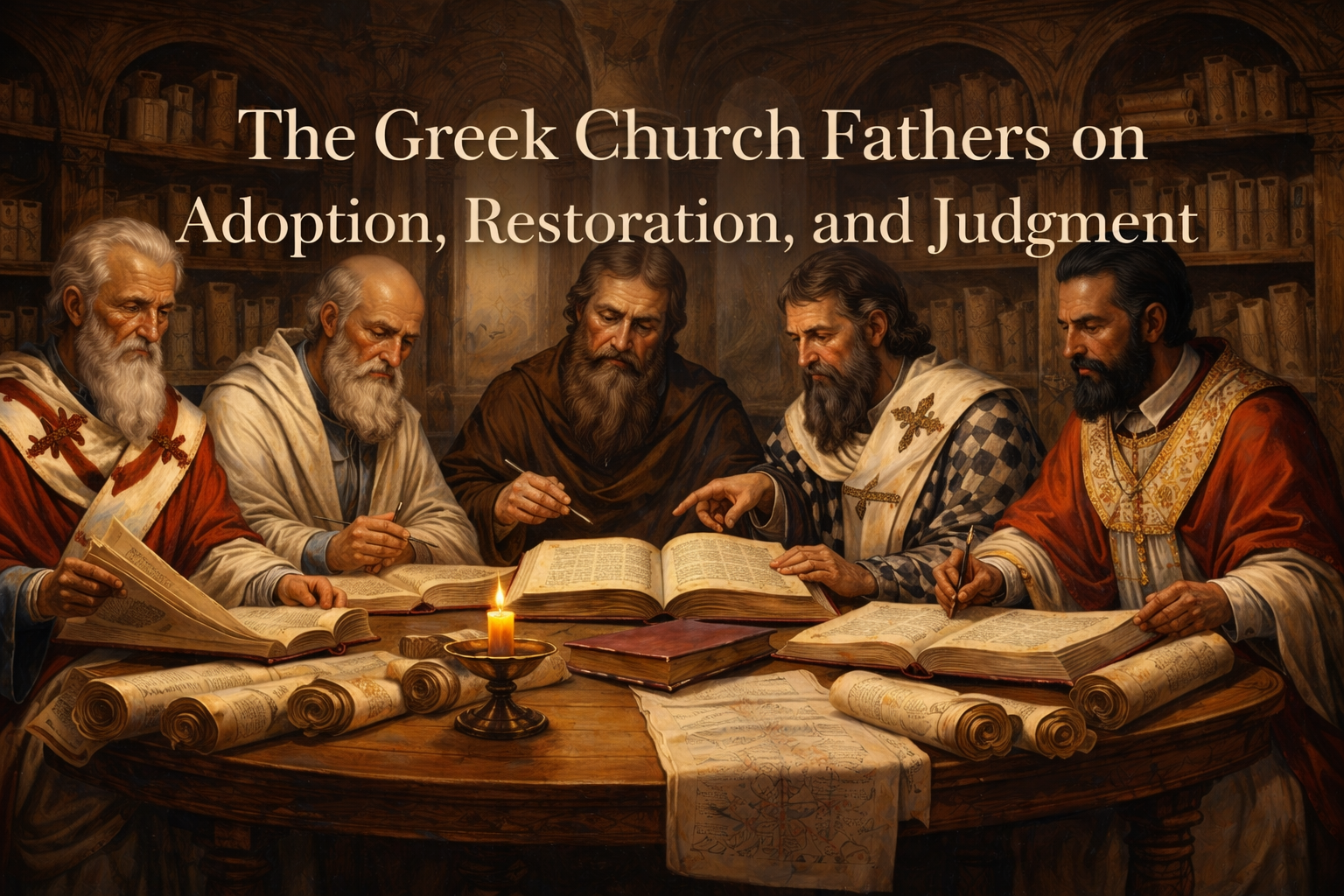
And How the Early Greek Fathers Harmonized John and Paul Without Eternal Torment
The earliest Greek-speaking Church Fathers approached Scripture within a theological framework shaped by creation, incarnation, and restoration. Long before later Western debates about eternal punishment hardened into rigid systems, these theologians read John and Paul as presenting a unified vision of humanity’s origin and destiny. For them, divine sonship was rooted in creation and fulfilled through redemption, not permanently lost through sin.
Writers such as Irenaeus of Lyons emphasized humanity’s original status as God’s children, created for maturity and communion. Sin, in his view, produced immaturity and alienation rather than ontological ruin. Christ’s work restores growth and completes humanity’s vocation. Adoption language, therefore, described advancement into spiritual adulthood rather than replacement of a failed creation.1
Clement of Alexandria interpreted moral evil as the result of misdirected desire and ignorance. For him, Satan exercised influence through deception, not creative authority. When Scripture spoke of “children of the devil,” Clement understood this as imitation of vice, not loss of divine origin. Divine judgment, accordingly, functioned pedagogically, aiming at moral healing.2
Origen of Alexandria developed this logic further. He insisted that God alone is the source of rational beings and that evil has no independent substance. Participation in evil constituted estrangement, not re-creation. Origen interpreted Paul’s adoption language as the final restoration of rational creatures to their intended harmony under God.3
In the fourth century, Athanasius of Alexandria grounded salvation in the incarnation. The Word assumed human nature precisely because humanity belonged to God. Redemption, therefore, reclaimed what was already God’s possession. Adoption described humanity’s reintegration into divine life through Christ’s victory over corruption and death.4
Similarly, Gregory of Nyssa argued that evil is parasitic and temporary. Since humanity bears God’s image, no amount of sin can erase its fundamental orientation toward the good. For Gregory, divine justice aims at purification and restoration, leading ultimately to universal harmony under God’s sovereignty.5
These Greek Fathers consistently rejected the idea that Satan could become a true father or creator of humanity. They also avoided interpreting divine judgment as eternally fixing creatures in rebellion. Instead, they harmonized John’s ethical language and Paul’s adoption theology within a restorative narrative: creation establishes sonship, sin disrupts fellowship, and Christ restores and perfects God’s family.
Only later, particularly through the influence of Augustine of Hippo, did Western theology increasingly emphasize inherited guilt and irreversible division. The earlier Greek tradition retained a stronger emphasis on healing, participation, and consummation. Their witness demonstrates that John and Paul were originally read in ways compatible with restorative rather than retributive eschatology.6
Brother Roger
Endnotes
- Irenaeus of Lyons, Against Heresies, 3.18.1–7; 4.38.1–4, in The Ante-Nicene Fathers, vol. 1, ed. Alexander Roberts and James Donaldson (Peabody, MA: Hendrickson, 1994), 448–451, 521–523.
Irenaeus presents salvation as the restoration and maturation of humanity’s original filial relationship with God through Christ’s recapitulating work. ↩︎ - Clement of Alexandria, Stromata, 7.2–3; Paedagogus, 1.6, in The Ante-Nicene Fathers, vol. 2 (Peabody, MA: Hendrickson, 1994), 527–531, 215–218. Clement emphasizes divine pedagogy, interpreting punishment and discipline as instruments of moral restoration rather than retributive destruction. ↩︎
- Origen of Alexandria, On First Principles (De Principiis), 1.6.1–3; 2.10.1–5, trans. G. W. Butterworth (Gloucester, MA: Peter Smith, 1973), 74–78, 155–160. Origen argues that rational creatures originate from God alone and that divine judgment serves the ultimate restoration (apokatastasis) of creation. ↩︎
- Athanasius of Alexandria, On the Incarnation, §§8–10, 54–57, trans. A Religious of C.S.M.V. (Yonkers, NY: St. Vladimir’s Seminary Press, 1998), 37–45, 94–101. Athanasius grounds redemption in the Incarnation, arguing that the Word restores humanity because it already belongs to God by creation. ↩︎
- Gregory of Nyssa, On the Soul and the Resurrection; The Great Catechism, §§26–35, in Nicene and Post-Nicene Fathers, Series II, vol. 5 (Peabody, MA: Hendrickson, 1994), 439–468, 483–495.
Gregory teaches that evil is temporary and parasitic, and that divine justice aims at purification and restoration rather than eternal fixation in sin. ↩︎ - Augustine of Hippo, Enchiridion, §§112–115; City of God, 21.17–23, trans. Henry Bettenson (London: Penguin, 2003), 327–331, 973–990.
Augustine represents the developing Western emphasis on eternal punishment and inherited guilt, marking a shift from earlier restorative interpretations. ↩︎
Leave a Reply