
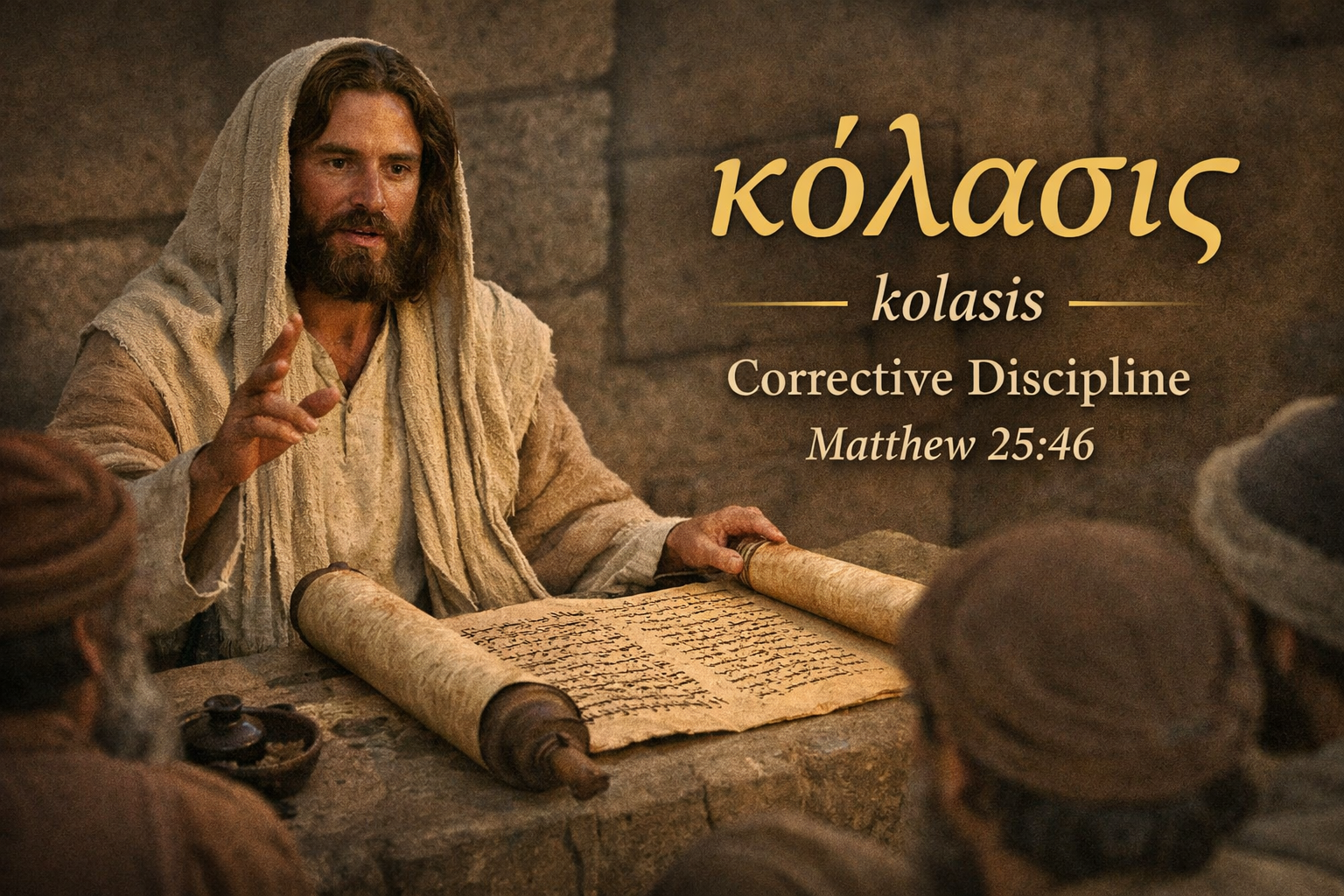
One of the most debated passages in the New Testament concerning judgment is Matthew 25:46.1 In many English translations it reads:
“And these will go away into eternal punishment, but the righteous into eternal life.”
For centuries this verse has been cited as proof of endless punishment. Yet when we examine the language behind the text, particularly the Greek word kolasis2 and the Aramaic wording preserved in the Syriac Peshitta,3 a much richer picture emerges. These linguistic clues suggest that the punishment described in this verse may have originally been understood as corrective discipline rather than retributive torment.
Understanding the Aramaic background of Jesus’ teaching can therefore help us read the passage more carefully and more faithfully.
The Syriac Peshitta: An Early Aramaic Witness
The Peshitta is the ancient Syriac (Aramaic) translation of the New Testament used by Eastern Christian communities. Syriac is a dialect of Aramaic closely related to the language spoken in the region where Jesus lived and taught.
In the Peshitta, Matthew 25:46 reads:
ܘܢܐܙܠܘܢ ܗܠܝܢ ܠܬܘܪܨܝܐ ܕܠܥܠܡ ܘܙܕܝܩܐ ܠܚܝ̈ܐ ܕܠܥܠܡ
Transliterated:
W’neʾzlun hālēn l-turṣāyā d-ʿālam, w-zaddiqē l-ḥayyē d-ʿālam.
A very literal translation would read:
“And these will go to the correction of the age, but the righteous to the life of the age.”
Two key terms in this verse deserve special attention.
The Meaning of “Turṣāyā”: Correction or Discipline
The Syriac word ܬܘܪܨܝܐ (turṣāyā) is used where the Greek New Testament has the word κολασις (kolasis).4
In Syriac usage, turṣāyā carries meanings such as:
- correction
- discipline
- reformation
- setting something right
The underlying idea is restoration rather than revenge. It refers to the process of straightening what has become crooked or bringing something back into proper order.
This meaning aligns closely with the classical Greek sense of kolasis. In earlier Greek literature, kolasis referred to corrective punishment intended to improve the offender, much like pruning a plant to encourage healthy growth.5
Importantly, Greek also had another word for punitive vengeance—τιμωρία (timoria)—but this word was not used in Matthew 25:46.
The Meaning of “ʿĀlam”: The Age
The second key word in the Syriac verse is ܥܠܡ (ʿālam), which corresponds to the Greek word αἰών (aiōn). This word does not inherently mean “eternal” in the philosophical sense of endless duration. Rather, it refers to:
- an age
- an era
- a long but defined period
- a world-order or epoch
Thus the phrase ܕܠܥܠܡ (d-ʿālam) literally means “of the age” or “age-lasting.” In Matthew 25:46, the same phrase describes both outcomes:
- correction of the age
- life of the age
The contrast in the verse is therefore not between temporary punishment and endless life, but between two realities belonging to the coming age of God’s kingdom.6
Why the Greek Translators Used “Kolasis”
The authors of the New Testament wrote in Greek, even though Jesus most likely taught primarily in Aramaic. When translating Jesus’ teachings into Greek, the writers had to choose words that best conveyed the meaning of His original language. Among the available Greek terms for punishment, they selected kolasis, a word historically associated with corrective discipline.7 This choice suggests that the punishment described in Matthew 25:46 was understood in the early Christian linguistic environment as a form of moral correction rather than purely retributive suffering.8
The Broader Biblical Pattern of Discipline
The concept of corrective discipline runs throughout Scripture. For example, the Epistle to the Hebrews teaches:
“The Lord disciplines the one He loves, and chastens every son whom He receives.” (Hebrews 12:6)
Here discipline is not a sign of rejection but of fatherly care. Its purpose is restoration and growth. This same restorative pattern appears repeatedly in the biblical narrative: God judges in order to heal, correct, and ultimately restore.
Reading Matthew 25:46 in Light of Its Language
When the linguistic evidence from both Greek and Aramaic is considered, Matthew 25:46 may be understood more precisely as describing:
“age-lasting corrective discipline” contrasted with “age-lasting life.”
Rather than portraying judgment as endless retribution, the language points toward a process belonging to the coming age in which wrongs are set right and justice restores order. Such an interpretation harmonizes with the broader biblical theme that God’s justice and God’s love are not in conflict. Instead, divine judgment often functions as the very means through which God brings about healing and restoration.
Augustine and the Latin Reinterpretation
A major shift occurred in Western theology through the influence of Augustine of Hippo (AD 354–430).
Augustine worked primarily in Latin rather than Greek, and the Latin Bible translated aiōnios with the word aeternus, which strongly implies absolute endlessness. Because of this linguistic difference, Augustine interpreted Matthew 25:46 as teaching that punishment must be eternal in the same sense as eternal life.
In The City of God, Augustine argued that if the life promised to the righteous is endless, then the punishment of the wicked must also be endless, since the same adjective describes both.
Augustine’s immense influence in Western Christianity meant that his interpretation eventually became the dominant view throughout medieval theology and later Western traditions.
Two Interpretive Traditions
As a result of these developments, two different interpretive traditions emerged in Christian history.
Greek Eastern Tradition
- Aiōnios understood as belonging to an age
- Judgment often viewed as purifying or corrective
- Emphasis on God’s ultimate restoration of creation
Latin Western Tradition
- Aiōnios translated as eternal in the absolute sense
- Judgment interpreted as endless punishment
- Strong influence from Augustine’s theology
Why This Matters for Matthew 25:46
When the historical and linguistic evidence is considered, the phrase “kolasis aiōnios” may naturally be understood as:
“age-lasting corrective discipline.”
This reading aligns with the classical meaning of kolasis, the broader biblical theme of divine discipline, and the interpretations offered by several early Greek theologians.
At the very least, the history of interpretation shows that the meaning of Matthew 25:46 has not always been understood in the same way. The debate surrounding this verse reflects a deeper conversation about how divine justice and divine love ultimately work together in God’s redemptive plan.
Augustine wrote primarily in Latin rather than Greek, and his theological framework was shaped by the Latin term poena, which carried stronger connotations of penalty and retribution. In his influential work The City of God, Augustine argued that the punishment described in Matthew 25:46 must be eternal in duration, because the same adjective (aiōnios) describes both punishment and life.
Because Augustine became the dominant theological authority in Western Christianity, his interpretation profoundly shaped the doctrine of eternal conscious torment in medieval Latin theology. Over time, this interpretation became widely assumed in Western Christianity, even though earlier Greek-speaking theologians had often understood the language of judgment differently.
This historical development helps explain why the meaning of kolasis in Matthew 25:46 has been debated throughout Christian history. The linguistic evidence from both Greek and Syriac suggests a meaning rooted in corrective discipline, while later theological traditions increasingly interpreted the verse through the lens of retributive punishment.
Linguistic Comparison of Matthew 25:46
Table: Linguistic comparison of Matthew 25:46 showing how translation choices—from Greek and Syriac to Latin and English—shaped the interpretation of “kolasis aiōnios.”
| Source | Text | Key Term for Punishment | Meaning Emphasis |
|---|---|---|---|
| Greek New Testament | καὶ ἀπελεύσονται οὗτοι εἰς κόλασιν αἰώνιον, οἱ δὲ δίκαιοι εἰς ζωὴν αἰώνιον | kolasis aiōnios | corrective punishment belonging to the age |
| Syriac Peshitta | ܘܢܐܙܠܘܢ ܗܠܝܢ ܠܬܘܪܨܝܐ ܕܠܥܠܡ ܘܙܕܝܩܐ ܠܚܝ̈ܐ ܕܠܥܠܡ | turṣāyā d-ʿālam | correction or discipline of the age |
| Latin Vulgate | Et ibunt hi in supplicium aeternum, iusti autem in vitam aeternam | supplicium aeternum | eternal punishment |
| King James Version (1611) | “And these shall go away into everlasting punishment, but the righteous into life eternal.” | everlasting punishment | eternal duration |
| New International Version | “Then they will go away to eternal punishment, but the righteous to eternal life.” | eternal punishment | eternal duration |
| Young’s Literal Translation | “And these shall go away to punishment age-during, but the righteous to life age-during.” | age-during punishment | duration connected to an age |
| Rotherham Emphasized Bible | “And these shall go away into age-abiding correction, but the righteous into age-abiding life.” | age-abiding correction | disciplinary emphasis |
A short timeline showing the historical shift of interpretation
AD 150 — Greek Fathers interpret judgment restoratively
AD 250 — Origen teaches purifying judgment
AD 390 — Gregory of Nyssa teaches ultimate restoration
AD 420 — Augustine formalizes eternal punishment doctrine
AD 1200 — Medieval theology solidifies ECT
Conclusion
Examining Matthew 25:46 through the lens of the Aramaic Syriac Peshitta reveals important nuances that are often lost in translation. The key terms used in the verse—turṣāyā for correction and ʿālam for age—suggest that the original meaning may have emphasized discipline belonging to the age to come, not necessarily endless punitive torment.
This linguistic perspective invites readers to reconsider how the Bible portrays judgment. Far from contradicting the character of a loving God, divine correction may instead reflect His determination to set the world right and bring His creation into restoration.
Understanding the linguistic background of Matthew 25:46 does not remove the seriousness of divine judgment. Rather, it reveals a vision of judgment consistent with the character of a God who disciplines in order to heal, correct, and ultimately restore. When the Greek and Aramaic evidence is considered together, we can see how the passage points less toward endless punishment and more toward the age-long process through which God sets His creation right.
Brother Roger
Endnotes:
- Gospel of Matthew 25:46 (Greek text):
“καὶ ἀπελεύσονται οὗτοι εἰς κόλασιν αἰώνιον, οἱ δὲ δίκαιοι εἰς ζωὴν αἰώνιον.” The key terms are κόλασις (kolasis) and αἰώνιος ( ↩︎ - The distinction between κόλασις (kolasis) and τιμωρία (timoria) is discussed in Aristotle, Rhetoric 1.10.17, where kolasis is described as punishment for the sake of the offender (corrective), whereas timoria refers to vengeance for the sake of the one offended. ↩︎
- The Peshitta is the standard Syriac (Aramaic) translation of the Bible used by many churches in the Middle East. The word Peshitta means “simple,” “straight,” or “common” in Syriac, indicating that it was the ordinary Bible used by Syriac-speaking Christians.
Because Syriac is a dialect of Aramaic, the Peshitta preserves the Scriptures in a language very close to the language spoken by Jesus and the early Jewish-Christian community. ↩︎ - The Syriac word ܬܘܪܨܝܐ (turṣāyā) carries meanings such as correction, discipline, or setting something right. See J. Payne Smith, A Compendious Syriac Dictionary (Oxford: Clarendon Press, 1903), 598.
↩︎ - In classical Greek literature, κόλασις (kolasis) referred primarily to corrective punishment intended to improve the offender. See Aristotle, Rhetoric 1.10.17, where he contrasts kolasis (disciplinary punishment) with timoria (vengeful retribution).
Over time, particularly in later Hellenistic and Latin theological contexts, the corrective nuance of kolasis was increasingly overshadowed by a more retributive interpretation. See William Barclay, A Spiritual Autobiography (Grand Rapids: Eerdmans, 1977), 66–67.
Lexical studies confirm the earlier corrective sense. See Gerhard Kittel and Gerhard Friedrich, eds., Theological Dictionary of the New Testament, vol. 3 (Grand Rapids: Eerdmans, 1965), 816–822. ↩︎ - The word ܥܠܡ (ʿālam) in Syriac and αἰών (aiōn) in Greek commonly refer to an age, epoch, or world-period, rather than strictly endless duration. See G. W. H. Lampe, A Patristic Greek Lexicon (Oxford: Clarendon Press, 1961), 45–48. ↩︎
- Early Christian writers often interpreted divine punishment as corrective. For example, Gregory of Nyssa described judgment as a purifying process through which evil is ultimately removed from creation (On the Soul and the Resurrection). ↩︎
- Similarly, Origen taught that divine judgments function as therapeutic discipline intended to restore the soul, comparing them to a physician’s treatment rather than vindictive punishment (De Principiis 2.10). ↩︎
Leave a Reply