
Yeshua in Deuteronomy 1:1–3:22 and Universalist Themes in Light of Hebrews 3:5 and Acts 3:21
Moses Testified of Yeshua
Hebrews 3:5 declares, “Now Moses was faithful in all His house as a servant, for a testimony of those things which were to be spoken later.” The writer of Hebrews explains that Moses’ ministry was never an end in itself. Everything Moses wrote ultimately testified about Someone greater who would come later—Yeshua the Messiah. This truth harmonizes beautifully with Yeshua’s own words in Luke 24:44, where He taught that everything written in the Law of Moses pointed toward Him. Deuteronomy begins as Moses’ final series of Divinely inspired precepts before Israel enters the Promised Land. Looking back over forty years of wilderness history, Moses repeatedly reveals themes that ultimately find their fulfillment in Yeshua. Read alongside Peter’s words in Acts 3:21 concerning “the restoration of all things,” these opening chapters also contain remarkable themes that many Christian universalists believe anticipate God’s final purpose of restoring His creation.
Yeshua the Greater Moses
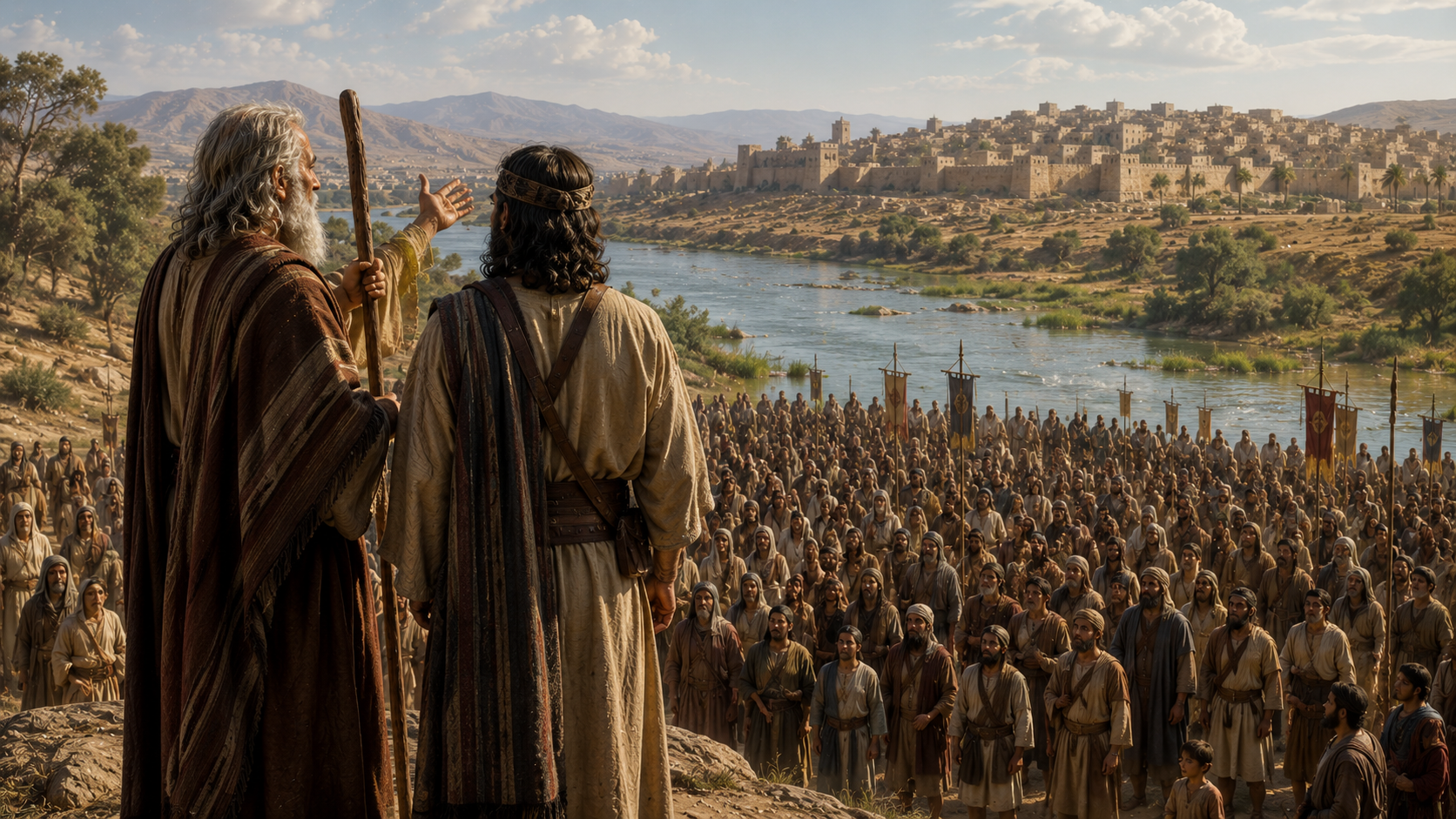
The opening chapters of Deuteronomy present Moses reviewing Israel’s history and preparing the nation for life in the Promised Land. Moses functions as teacher, lawgiver, shepherd, intercessor, and covenant mediator. Yet Hebrews makes clear that Moses himself was only a servant pointing beyond himself to Someone greater. Yeshua fulfills every role Moses occupied. Moses gave the Law; Yeshua fulfills the Law. Moses led Israel through the wilderness; Yeshua leads His people into the everlasting Kingdom. Moses mediated the old covenant; Yeshua mediates the new and better covenant. Moses faithfully served God’s house; Yeshua is the Son over God’s house. Thus the entire setting of Deuteronomy quietly prepares readers to recognize the coming Messiah.
Universalist Theme: The Faithfulness of God Across Generations
Moses begins by reminding Israel of God’s faithfulness despite forty years of failure. An entire generation perished in the wilderness because of unbelief, yet God never abandoned His covenant. He faithfully raised up a new generation to receive the inheritance He had promised. Universalists often see this pattern as revealing a God whose purposes continue despite human rebellion. Divine discipline may delay blessing, but it does not ultimately cancel God’s covenant intentions. This principle harmonizes with Acts 3:21, where God’s purposes continue moving history toward the restoration of all things.
Yeshua the Wise Judge
In Deuteronomy 1, Moses recalls appointing judges to help govern Israel. They were instructed to judge impartially, showing no favoritism because judgment ultimately belongs to God. Christians see in this an anticipation of Yeshua, the perfectly righteous Judge. Unlike every earthly judge, Yeshua judges with complete wisdom, mercy, and truth. His judgments are never distorted by appearances or prejudice. All those appointed judges at the suggestion of Jethro as recorded in Exodus 18 did not bring peace to the people. Only Yeshua the Prince of Peace can do that. The New Testament repeatedly declares that all judgment has been entrusted to the Son, whose justice is perfectly united with compassion.
Universalist Theme: Judgment Serves Righteousness
Universalists acknowledge that judgment is an essential aspect of God’s character and plan, yet they emphasize that Scripture consistently presents God’s judgments as serving righteousness and restoration. The judges appointed by Moses existed to establish justice within the brawling community but failed. Yeshua’s judgments reveal truth, expose evil, and ultimately serve God’s redemptive purposes as He brings us into a one-on-one relationship with The Father. Universalists therefore understand divine judgment as restorative justice directed toward healing creation rather than perpetuating endless contention and ruin.
Yeshua the Faithful Leader Despite Human Unbelief
Deuteronomy 1 recounts Israel’s refusal to enter the Promised Land after hearing the fearful report of the spies. Their unbelief delayed the fulfillment of God’s promise. Yet God did not abandon His people. Instead, He continued leading them through the wilderness until a new generation was prepared to enter the land. Christians see Yeshua reflected in this patient leadership. He remains faithful even when His followers struggle with fear, doubt, and failure. He continues guiding His people toward the inheritance He has prepared.
Universalist Theme: Human Failure Does Not Defeat God’s Purpose
One of the strongest universalist themes in these chapters is the contrast between human failure and divine perseverance. Israel’s unbelief was real, yet God’s purposes remained intact. His covenant continued moving forward despite repeated disobedience. Universalists often see this pattern throughout Scripture. Human resistance may delay God’s blessings, but it cannot permanently frustrate His ultimate purpose. Acts 3:21, speaking of prophets, and Moses was a prophet, Deuteronomy 18:15 and 34:10, likewise portrays history progressing toward restoration because God’s faithfulness proves stronger than human rebellion as foretold by the prophets.
Yeshua the Conqueror of Kings
Chapters 2 and 3 recount Israel’s victories over Sihon, king of Heshbon, and Og, king of Bashan. These victories demonstrate that no earthly ruler can ultimately withstand God’s purposes. Christians understand these military victories as shadows pointing toward Yeshua’s far greater conquest. Rather than defeating merely human kings, Yeshua conquers sin, death, Satan, and every spiritual power opposed to God’s Kingdom. His resurrection announces the decisive victory that all earlier battles merely anticipated.
But What About?
“And we utterly destroyed them, as we did to Sihon king of Heshbon, utterly destroying the men, women, and children of every city.” Deuteronomy 3:6
Yahweh destroyed the evil Hamas people of Noah’s day. “The earth was filed with violence,” Genesis 6:11-13, and the Hebrew word translated as violence is Hamas, or in its guttural form Chamas. Yes, their evil violent bodies and souls were destroyed, but their spirits returned to Father Yahweh, Ecclesiastes 12:7, where they were held in “prison,” a “treasury” (see the footnote below) until Yahshua/Yeshua would go via His spirit and proclaim the gospel to those “who ONCE were disobedient, 1 Peter 3:18-20 NASB, so that though “they are judged in the flesh as men, they may live in the spirit according to the will of God.” 1 Peter 4:6. This is an early example of how Father Yahweh will ultimately restore and save all those who had been judged with destruction here on earth, with their young offspring. He is no respecter of persons. If He did it for the evil people of Noah’s day He will do it for the people destroyed by the sons of Israel as they conquered the promised land1.
Universalist Theme: God Distinguishes Between Judgment and Promise
During Israel’s journey, God instructs them not to attack Edom, Moab, or Ammon because those nations had also received territories according to His sovereign purposes. This remarkable detail demonstrates that God’s care extends beyond Israel alone. Even nations outside the covenant receive His providential guidance and blessing, although they often disregard such. Universalists frequently point to such passages as evidence that God’s concern has always extended to all peoples, not merely one nation. Israel’s election served a larger purpose—the eventual blessing of all nations through the Messiah.
Yeshua the Giver of the Inheritance
Throughout these chapters, Moses repeatedly speaks of the land God is giving His people. The inheritance is presented not as something Israel earned but as a gracious gift flowing from God’s covenant faithfulness. Christians see this inheritance ultimately fulfilled in Yeshua. He secures the eternal inheritance for His people through His death and resurrection. The earthly land becomes a picture of the greater inheritance awaiting all who belong to Messiah: the renewed creation where righteousness dwells.
Universalist Theme: The Promise Points Beyond Canaan
Universalists often observe that the biblical idea of inheritance continually expands throughout Scripture. The promise begins with Canaan but grows through the prophets into the renewal of the whole earth. Peter’s vision of the restoration of all things, Paul’s teaching that creation itself will be set free from corruption, and John’s vision of a new heaven and new earth all enlarge the original promise. The inheritance ultimately embraces God’s restored creation under the reign of Yeshua.
Yeshua the Courage of His People
As Moses commissions Joshua, he repeatedly commands him, “Do not fear.” Joshua’s confidence is to rest not in military strength but in God’s presence. Christians recognize this as another portrait of Yeshua, whose very Hebrew name—Yehoshua—matches Joshua’s. Joshua led Israel into the earthly Promised Land; Yeshua leads His people into the everlasting Kingdom. Both names proclaim that “Yahweh saves,” yet the greater Joshua accomplishes an eternal salvation extending far beyond the conquest of Canaan.
Universalist Theme: God’s Presence Guarantees the Fulfillment of His Purpose
Moses encourages Joshua by reminding him that the Lord Himself goes before His people and fights for them. Universalists often see in this a profound picture of God’s unwavering commitment to accomplish His redemptive purposes. If the success of redemption depended upon human strength, it would surely fail. But because Yahweh Himself leads the journey, His purposes cannot ultimately be defeated. Acts 3:21 presents this same confidence on a cosmic scale: history itself is moving under God’s sovereign guidance toward the restoration of all things.
Conclusion: Moses Testified of the Messiah Yet to Come
The opening chapters of Deuteronomy reveal far more than Israel’s past. They prepare readers for Yeshua, the greater Moses, the righteous Judge, the faithful Shepherd, the victorious King, the giver of the eternal inheritance, and the greater Joshua who leads His people into God’s everlasting Kingdom. Alongside these portraits runs a consistent thread that many Christian universalists find deeply significant. God’s covenant faithfulness overcomes human failure. His judgments establish righteousness. His concern extends beyond Israel to the nations. His inheritance expands beyond one land to encompass a renewed creation. His purposes continue despite rebellion because He Himself remains faithful. For this reason, many universalists see Deuteronomy 1:1–3:22 as harmonizing beautifully with Acts 3:21. Moses’ testimony points forward not only to the coming of Yeshua but also to the day when God’s ancient promises reach their glorious fulfillment in the restoration of all things through Israel’s Messiah, the Savior of the world.
Brother Roger
Enjoy the supporting song
- Joshua 6:17-19 “The city shall be under the ban, it and all that is in it belongs to the LORD (Yahweh); … “But all the silver and gold and articles of bronze and iron are holy to the LORD; they shall go into the treasury of the LORD.” (See my blog Plundering the Egyptians.)The Hebrew word translated as treasury is otsar, Strong’s Concordance #H214 meaning depository, and it derives from a root word atsar meaning to store up. Cogitate on that! ↩︎
Leave a Reply